Monday, February 04, 2008

A Toast to the Constitution: Temperance, A Benevolent Creator/Brewmaster, Happiness & Avoiding the Gout

Here's the toast from the 222nd Annual Constitutional Law Mixer, held at Columbia Law School on February 4, 2008. As in years past, the event was jointly hosted by the local chapters of the American Constitution Society, the Federalist Society, and the Constitution Law faculty here at Columbia.

First, I want to thank ACS & FedSoc for inviting me to give a toast at the 222nd Annual Constitutional Law Mixer. It's an honor to be a part of a tradition that predates both interchangeable parts and modern plumbing.

As Chancellor Kent was known to say: "Our annual Con Law Mixer? Yeah, that's kind of a big deal."

Back in May of last year, I stumbled across Robert Harris's review of the Barbara Holland book The Joy of Drinking. In Harris's review, he noted Holland's research into the role alcohol played in the creation of the United States Constitution. Harris writes that:
[I]n 1787, two days before their work was done, the 55 delegates to the Constitutional Convention “adjourned to a tavern for some rest, and according to the bill they drank 54 bottles of Madeira, 60 bottles of claret, 8 of whiskey, 22 of port, 8 of hard cider and 7 bowls of punch so large that, it was said, ducks could swim around in them. Then they went back to work and finished founding the new Republic.” Note the 55 delegates and 54 bottles of Madeira. Which founder was slacking?
PG, a recent CLS graduate and the only person I know whose Constitutional leanings led her to be an active member of both ACS and the Federalist Society, speculated that Thomas Mifflin – at the time the sitting President of Pennsylvania and a Quaker prior to his expulsion for serving in the Continental Army – was the teetotaler; however, given the amount of drink involved, it's unsurprising that the identity of the true abstainer would be lost to history.
Perhaps it was the drink, but there's so much about the Constitution that's been lost to history, so much that the Founders forgot to tell us about the meaning and the crafting of this founding document:
  • Dear Founders, is that a comma, a semi-colon, or a fleck of dirt?

  • O Breech-pants-wearing Founders, is the office of the Vice President firmly seated within the executive branch, or is it an extra-constitutional floater, like the extra outfielder in a game of slow-pitch softball?

  • O Founders, did you really believe that human nature would permit the loser of the Presidential election to serve as a good Vice-President to the winner?

  • Founders, why-oh-why did you decide to capitalize nearly every noun in the Constitution? ...and what's the deal with the handful you didn't capitalize? (...and 1L's: That's a gangbuster note topic, by the way.)

  • O Founders, are there secret messages in your tortured and inconsistent spellings?
Ultimately, we just don't know the answers to any of these vital questions, so we're left to make like the founders and drink a little Madeira, claret, whiskey, port and hard cider — maybe that will bring some clarity. (Incidentally, I was told that this event would have a bowl of punch so large that ducks could swim in it. Maybe that's coming later.)

In finishing my toast and finally raising a glass, I want to end with a meditation.

Let's meditate upon how the Constitution would have looked if Ben Franklin had had more creative control over the text. After all, historians report that when Thomas Jefferson sent Franklin a draft of the Declaration of Independence containing the line "We hold these truths to be sacred and undeniable," Franklin returned it to him with the last three words crossed out and replaced by "self-evident." Surely the person responsible for this memorable and meaningful term into the Declaration of Independence could have helped us more with the Constitution. (By the way, for those of you who are measuring the productivity of your lives against the lives of the Founders or choosing your political candidates on the basis of age, please note that Thomas Jefferson was all of 33 years old when he helped draft the Declaration of Independence.)

Now, I happen to know what Franklin would have done if he'd had his way with our overly short & oft-confusing Constitution. He would have included two final clauses.

In fact, I know which clauses Franklin would have inserted.

Truth be told, I find the tension between these two clauses to be roughly analogous to the on-going dialogue that occurs between the Federalist Society & ACS.

The first clause is a quote of Franklin's, taken from Poor Richard's Almanack, 1734. To me, this is the Federalist Society clause: "Be temperate in wine, in eating, girls, and sloth, or the gout will seize you and plague you both."

The second clause does not appear in any published writing of Franklin's, but has been broadly attributed to him. Naturally, the lack of textual basis for this quote (and its feel-good character) makes it more appropriate for ACS. The clause is: "Beer is proof that God loves us and wants us to be happy."

So please join me in raising a glass: Here's to Franklin, to the other Founders, to their strange and wondrous Constitution, to ACS, to the Federalist Society, to being happy, and – above all – to trying our best to avoid the gout.

CHEERS!

Labels: , ,

Thursday, September 13, 2007

The President's Pen: Negating Congressional Initiative and Hampering Effective Policy

The presidential signing statement is not new. Its been around for a long, long time, but the frequency with which this President has employed it is staggering. Between 1817 and 1981, only 75 such statements were issued from the White House. As of June 2006, President Bush had issued over 600. (For an excellent overview of Bush's use of signing statements, www.beyondpartisan.org). It is true that Presidents Reagan and Clinton issued signing statements at a far greater rate than their predecessors, this executive has implemented the form for the purposes of participating in a purely legislative process: the determination of what issues federal legislation should address.

This is what bothers me most about President Bush's use of the signing statement. He is effectively telling Congress, "I understand that you have identified a social problem, but I disagree with the means you chose to address is (or perhaps that it is a problem at all). Thus, I will abandon my Constitutional duty of implementation, because you, vox populi, are talking jive."


It's fun to eviscerate democracy!

The first signing statement issued by President Bush is illustrative of this point. Congress, in passing the Animal Disease Risk Assessment, Prevention, and Control Act, instructed the Secretary of Agriculture to provide reports including legislative recommendations on various issues of animal disease prevention. President Bush's signing statement objected to Congress' temerity in telling his employee what to do. The merit of the administration's fundamental separation of powers argument here is beyond my capacity or present interest to assess, but this example is telling on a more basic level.

Here, Congress has responded to widespread public apprehension about diseases carried by animals and their potential communicability to humans or impact on the food supply. (Remember Avian Flu?) The President - whether or not he agreed that this was an important problem with a role for the federal government in tackling it (it looks like he did, given that his CDC has been training to deal with a potential Avian Flu pandemic) - squelched a useful avenue for the provision of valuable scientific expertise to the Legislature for reasons boiling down to a juvenile bureaucratic turf war. Congress saw a problem, realized it needed expert assistance to effectively legislate against it, and asked for that aid. President Bush ignored the public good, legislative and popular mandate, and the quest for effective policy solutions.

Perusing the index of signing statements published by ACS (pdf) is an interesting and frustrating endeavor. The exercise also reveals that President Bush has used signing statement to usurp judicial - in addition to legislative - powers. In many cases, the administration's reason for issuing a signing statement is that the particular provision at issue contravenes a constitutional provision or the Supreme Court's interpretation thereof. (Very often the signing statements invoke INS v. Chadha as prohibiting post-enactment participation of Congress in implementation decision-making).

While all government actors should consider the constitutionality of their actions at all times, the supreme arbiter of constitutionality is the Supreme Court (see e.g. Marbury v. Madison). This is especially true when applied to interpreting the Court's own precedents.

In the end, my overwhelming reaction to this important documentation of a little-known presidential tactic is quite blunt: I implore you Mr. President, KNOW YOUR ROLE. Let the Court and Congress to their respective jobs and you stick to the enduring inept execution of your own.

Labels: , ,

Wednesday, September 05, 2007

A Catalogue of Passed-But-Unenforced Legislation

Today, the national ACS website posted an interesting 229-page .pdf file. It's an index of all the Presidential Signing Statements issued between 2001-2007.

Although not specifically permitted or prohibited by the Constitution, signing statements provide notice how a President intends to enforce a law. According to the file on the ACS website, President Bush has used signing statements to lodge 1,047 objections to legislation signed into law.

Labels: ,

Monday, April 16, 2007

Neal Katyal: Lead Counsel for Hamdan

This evening, ACS along with SALSA, welcomed Neal Katyal to discuss the Supreme Courts’ 2006 decision in Hamdan v. Rumsfeld. Prof. Katyal was not only the lead counsel in Hamdan, he was co-counsel in Bush v. Gore, he clerked for Justice Breyer and Judge Calabresi, he served as National Security Adviser in the U.S. Justice Department, and he is currently the John Carroll Professor of Law at the Georgetown University Law Center.

Prof. Katyal first spoke about how he became involved in the case. He noted that as part of his job at the Justice Department and in his academic work, he has argued for a strong “Unitary Executive.” He distinguished this from the view of President Bush’s Administration which believes that when Congress has passed a law, through secret memos, the President can ignore that law when he feels that it unconstitutionally inhibits his power as Commander and Chief. For him, Hamdan is all about rejecting this view. “Congress calls the shots, not the President.” He cannot undo laws and treaties when he disagrees with them. There is some limited authority of the president in time of emergency, but this rarely happens in real life (only to Jack Bauer). There is some “residual emergency power” reserved by the President, but the question is how much and when—and the President’s answer has been as much as he wants and whenever.

In November of 2001, the President issued a military trial order and Katyal’s first impression was that it had to be a joke. The President was saying that he was going to set up a new trial system. He would define the offenses, the procedural rules, the rights (none), and the Federal Courts could not review it. Even as a person who favored a strong presidency, Katyal felt this went too far. The Administration argued that these trials where necessary and needed right away and there was no time to go to Congress. What if Osama bin Laden was caught before Congress acted? (He noted that Congress had passed by this time the Authorization for Use of Military Force and the Patriot Act).

It was for these reasons that Katyal began searching for a test case to challenge the President’s order. Charlie Swift (LCDR U.S. Navy) recommended Salim Ahmed Hamdan, who was the captured driver of bin Laden. Hamdan agreed to be represented by Katyal and Swift, and his case was filed. They argued that the trials violated the separation of powers, the Uniform Code of Military Justice ("UCMJ") which says how to conduct trials, and the Geneva Convention. The District Court agreed that this trial violated the separation of powers because it did not follow the UCMJ—specifically because Hamdan was kicked out of his own criminal trial. This apparently has not been allowed since the Star Chamber in England. At the D.C. Circuit they lost on appeal unanimously. Judge Williams, in his concurrence, did give some hope in rejecting the District Court’s decision that Common Article III of the Geneva Convention did not apply. Common Article III says that in all conflicts, the rights indispensable to all civilized people must be granted, but the Administration argued the since al-Qaeda did not sign the convention they do not get this protection. Katyal response was, “Whales didn’t sign the Whaling Convention.”

The Supreme Court granted cert, but Congress passed a bill to strip the case off of the Court’s docket. There was, however, an argument that the bill could be read to “grandfather” in Hamdan’s appeal. On 29 June 29th, 2006 the Court sided with Hamdan on all arguments. Katyal first impression upon leaving the court house was that the Court in a time of armed conflict told the President “No.” This guy with no financial means, who was accused of conspiring with one of this nation's worst enemies in its history, sued the President of the United States in the highest court in this land, and won. This is unique in this world. In many places, Hamdan would have been shot for doing this. Katyal quoted then Judge Roberts: “If the little guy’s argument is right, he wins.”

He then spoke about the Military Commissions Act (“MCA”) and his amazement that it was proposed by the President and passed by Congress in only three weeks. He believes it passed so fast because “it literally only effects people who cannot vote.” It only applies to green card holders and other non-citizens. American citizens, he said, “get the Cadillac of justice,” but if you are not a citizen “you get the beat up Chevy version of justice.” The first time Katyal met Hamdan, Hamdan asked Katyal why he was representing him when his last client was the Vice-President? Katyal thought of his parents, who came to the U.S. from India because of its commitment to equality and fairness. The MCA was violating this vision of America. Equal Protection of the laws under the 14th Amendment says “all persons” not “citizens.” This was done to overrule Dread Scott which limited constitutional rights to citizens only. Under the MCA, a separate trial system for foreigners has been set up, and it says that they only get a limited set of rights, while we get everything. That is why Katyal believes it is “doomed to fail.”

After the decision was handed down, the President and others in the Administration said that this would be a chance to paint Democrats as soft on the war on terror. Katyal expressed his shock that this was the President’s response. The first thing the President ever does is take an oath of office in which he swears to uphold the Constitution. The Supreme Court of the United States had just told the President that he violated the Constitution. The President, however, looked for the political gain that could be made from the decision. Since the war on terror has begun, no one has been brought to trial, and for Katyal “that is not a way to run a justice system.”

Katyal last spoke of a quote that was sent to him after the decision came out. It was the words written by Justice Rutledge in his dissent in the 1946 Supreme Court decision Yamashita v. Styer:
More is at stake than General Yamashita's fate. There could be no possible sympathy for him if he is guilty of the atrocities for which his death is sought. But there can be and should be justice administered according to law. In this stage of war's aftermath it is too early for Lincoln's great spirit, best lighted in the second inaugural, to have wide hold for the treatment of foes. It is not too early, it is never too early, for the nation steadfastly to follow its great constitutional traditions, none older or more universally protective against unbridled power than due process of law in the trial and punishment of men, that is, of all men, whether citizens, aliens, alien enemies or enemy belligerents. It can become too late.

This long-held attachment marks the great divide between our enemies and ourselves. Theirs was a philosophy of universal force. Ours is one of universal law, albeit imperfectly made flesh of our system and so dwelling among us. Every departure weakens the tradition, whether it touches the high or the low, the powerful or the weak, the triumphant or the conquered.
The person who sent it was not quoting the case. Rather, it was from a chapter on Rutledge written by one of the Justice’s former law clerks. That clerk, now Justice John Paul Stevens, made good on his boss’s promise fifty years later.

A good discussion followed Katyal’s remarks as well as a “delightful” reception. We would like to thank Professor Katyal for speaking with us this evening. We would also like to express thanks to Dechert LLP, Paul Weiss, Perkins Coie, Cleary Gottlieb Steen & Hamilton LLP, and Cravath, Swaine & Moore LLP for their generous support which made the evening possible.

Labels: , ,

Tuesday, April 03, 2007

SCOTUS Haiku with Professor Michael Dorf

A few months back, we twisted Professor Dorf's arm until he agreed to generate a haiku or two in quick response to notable SCOTUS opinions. His first haiku concerns yesterday's Massachusetts v. EPA (.pdf link):
The Earth gets hotter.
Massachusetts can complain.
EPA comply.

Labels: , ,

Monday, April 02, 2007

Climate Change, Public Goods, and Standing

DISCLAIMER: The following represents the uninformed reaction of a CLS 1L, utterly befuddled by constitutional law and lacking anything approaching the appropriate level of background knowledge or research. Although when has insufficient knowledge or research ever hindered anyone from posting something on the internet? So here we go.

     Climate change is a different kind of litigation. Legal scholars examined it through the lens of traditional causes of action (notably Professor Merrill’s Global Warming as Public Nuisance) and found it a problematic fit. The inability to project climate change into a conventional law suit derives primarily from the fact that a stable climate is not a private right that may be infringed upon. A stable climate is a public good.
     Economists define "public good," as anything with two main characteristics: public goods are nonrival in consumption and nonexcludable. The benefits of a stable climate are enjoyed by all of us simultaneously, though perhaps to varying degrees. A stable climate is nonexcludable in that those who pay for its maintenance cannot withhold the benefits of a preserved planet from those who shirk their contribution. The global climate is a public good, and the definitive characteristics of public goods are at odds with the traditional requirements for standing.
     Chief Justice Roberts rightly critiques any claim of the petitioners to conventional standing. The demand that a plaintiff’s injury be “particularized” and different in kind (as opposed to in degree) from others suffering due to the defendants’ conduct is clearly at odds with the global nature of climate change. The requirement of redressibility demands that the court be able to alleviate the injury suffered by the plaintiff through forcing the defendant to do something or pay some amount in damages. Any amelioration of climate change affected by an agency regulation on automobile emissions would be enjoyed by everyone world-wide. Certainly not a bad thing, but because the public good of climactic stability cannot be partitioned: the court cannot direct the benefits from reduced carbon dioxide emissions. The traditional requirements of standing cannot be neatly applied to an injury to a public good. This sends Justice Stevens upon a jurisprudential obstacle course in an attempt to draw standing from provisions of the Clean Air Act and case law dealing with procedural rights conferred by Congress. In that task, Stevens succeeds admirably, upon my reading at least.
     Chief Justice Roberts assuages the fears of environmentalists and rational actors alike by assuring us all that the political branches are an apt and appropriate forum for dealing with climate change. There are two practical problems with labeling climate change a “political question” and booting these petitioners out of court. First, environmental policy in general and climate change legislation in particular, suffers from an utter and acute failure of our political system. Presenting a classic problem of collective action, the beneficiaries of a stable climate are diffuse, unorganized, and susceptible to free-rider problems. Opponents of climate change regulation are, on the contrary, exceptionally well-organized, well-funded, and – until recently – highly motivated to fight regulatory change tooth and nail. In a very real sense, a Congress dependent upon campaign contributions is absolutely institutionally incompetent to deal with the problem of climate change in an independent and effective manner.
     While our adversarial judicial system may be equally ill-suited to adjudicate threats to public goods, the court is armed with an immutable weapon. The Supreme Court may, as it did yesterday, send a clear message to the “political branches” and their delegates in administrative agencies. The Court can say, in effect: “while we cannot complete the political tasks before you, we can, we must, and we do demand that you face common challenges rather than obfuscate them.” If the EPA, in response to the Court’s decision, or Congress, to supersede independent agency action pursuant to the decision, effectively addresses climate change, then the court will have redressed to the petitioners’ injuries. That is not a dismissive “political question” opinion. That is one co-equal branch checking another. That is the judiciary providing relief to the injured party before it. Though it faces an unfamiliar type of problem, that is the judiciary resolving a controversy. That is the role of the Court.

Labels: ,

Environmental Roll Call in Massachusetts vs. EPA?

Nearly half the states joined the landmark Massachusetts v. EPA (.pdf link), decided today by the Supreme Court.

The plaintiff side featured Massachusetts, California, Connecticut, Illinois, Maine, New Jersey, New Mexico, New York, Oregon, Rhode Island, Vermont, and Washington.

Amici curiae supporting the EPA were Alaska, Idaho, Indiana, Kansas, Michigan, Nebraska, North Dakota, Ohio, South Dakota, Texas, and Utah.

Labels: ,

Sunday, March 04, 2007

“A Separate Society”

Judicial deference, separation of powers, and Harrison Ford

On the bus ride to Boston for the Don’t Ask Don’t Tell conference hosted by HLS Lambda, I was forcibly treated to Harrison Ford’s invigorating defense of the Constitution in Clear and Present Danger. The movie was remarkably apt for the occasion, and two spot-on moments of melodrama managed to sneak in between the bullets and the bombs. When Harrison Ford (aka Dr. Jack Ryan, acting CIA deputy director of intelligence) first discovers a miniature undeclared war in Colombia authorized by the President, his boss tells him, “You took an oath…I don't mean the President. You gave your word to his boss: you gave your word to the people of the United States.” At the end of the movie, Ford leaves the President in the Oval Office with a look of utter scorn and testifies for the Senate Intelligence committee, apparently the arbiters of justice in the Tom Clancy world.

So what happens when the political branches are more or less united? Is it the place of the courts to question the judgment of the elected representatives of the people over the constitutionality of their policies? The answer is always and emphatically yes. Don’t Ask Don’t Tell is no exception, and as the conference panelists made clear, the Supreme Court needs to apply strict scrutiny to this discriminatory policy.

Professor Tim Bakken outlined the usual legal justifications for judicial deference to the judgment of Congress and the President:
  • a textual argument for granting the political branches power and authority, especially when they are in concurrence,

  • an argument of standard deference to Congressional fact-finding,

  • and an argument for deference to military findings and decisions as the expert in the field.
However, none of the legal justifications are the true reasons for Don’t Ask Don’t Tell because they reference the argument that DADT is necessary to preserve unit cohesion and military morale, an argument so flimsy even the Defense Department has backed away from it in recent years. Former service members told emotional stories explaining that rather than improving cohesion and morale, DADT caused harm by making them feel unwelcome and dishonorable. Professor Laurence Tribe encapsulated the crucial problem with DADT: it is based solely on the military’s discomfort with homosexuality. Discomfort is not a legal or constitutional justification.

Despite the current tendency towards judicial deference with regards to Don’t Ask Don’t Tell, the Supreme Court still has the power to act. As several of the panelists emphasized, deference does not equal abdication. The Court has deferred to military judgments on the importance of military interests and values, but DADT clearly does not fall within the logical scope of deference to the military. Even with judicial deference to Congress and the President, the constitutional standard of strict scrutiny does not change. That means the Court must find a compelling government interest which can only be served by DADT. The stated compelling interest and the “tailoring” or fit of DADT are both highly questionable.

Stuart Delery, currently representing a group of discharged service members in Cook v. Gates, is championing the argument that judicial deference operates within the Constitution, not as a replacement. Likewise, the military must operate within the limits of the Constitution. As Professor Tribe thundered into his microphone, the military is not a “Constitutional blackhole.”

Labels: , ,

Monday, February 12, 2007

Abraham Lincoln on Executive Options for Unauthorized, Preemptive War

On October 10 and October 11, 2002, the House of Representatives and the Senate, respectively, passed a joint resolution that came to be known as the Authorization for Use of Military Force Against Iraq Resolution of 2002. This resolution, signed by President Bush on October 16, 2002, specifically authorized the President to use our armed forces to "(1) defend the national security of the United States against the continuing threat posed by Iraq; and (2) enforce all relevant United Nations Security Council resolutions regarding Iraq." At the time of the resolution, the Executive Branch wanted a resolution authorizing military action throughout the Middle East, however, the Joint Resolution only authorizes military action in Iraq.

Current bellicose bluster from administration officials, direct White House involvement with intelligence assessments, military brass presentations, and aggressive troop movements in the Persian Gulf indicate that the Executive Branch may be interested in provoking a military or paramilitary response from Iran.

Beyond merely provoking an Iranian response, other sources close to the current administration claim that the Executive Branch may contemplate a preemptive, unprovoked strike against Iran, even without Congressional authorization.

If the Executive Branch's behavior were to constitute a first strike in a shooting war between the U.S. & Iran, Abraham Lincoln would likely consider the behavior unconstitutional at best and anti-republican at worst. He wrote this letter to his law partner, William Herndon, shortly after the culmination of the Mexican-American War. In an earlier letter, Herndon had argued that the President could initiate war against Mexico without Congress's prior authorization.

WASHINGTON, February 15, 1848.

DEAR WILLIAM:--Your letter of the 29th January was received last night. Being exclusively a constitutional argument, I wish to submit some reflections upon it in the same spirit of kindness that I know actuates you. Let me first state what I understand to be your position. It is that if it shall become necessary to repel invasion, the President may, without violation of the Constitution, cross the line and invade the territory of another country, and that whether such necessity exists in any given case the President is the sole judge.

Before going further consider well whether this is or is not your position. If it is, it is a position that neither the President himself, nor any friend of his, so far as I know, has ever taken. Their only positions are--first, that the soil was ours when the hostilities commenced; and second, that whether it was rightfully ours or not, Congress had annexed it, and the President for that reason was bound to defend it; both of which are as clearly proved to be false in fact as you can prove that your house is mine. The soil was not ours, and Congress did not annex or attempt to annex it. But to return to your position. Allow the President to invade a neighboring nation whenever he shall deem it necessary to repel an invasion, and you allow him to do so whenever he may choose to say he deems it necessary for such purpose, and you allow him to make war at pleasure. Study to see if you can fix any limit to his power in this respect, after having given him so much as you propose. If to-day he should choose to say he thinks it necessary to invade Canada to prevent the British from invading us, how could you stop him? You may say to him,--"I see no probability of the British invading us"; but he will say to you, "Be silent: I see it, if you don't."

The provision of the Constitution giving the war making power to Congress was dictated, as I understand it, by the following reasons: kings had always been involving and impoverishing their people in wars, pretending generally, if not always, that the good of the people was the object. This our convention understood to be the most oppressive of all kingly oppressions, and they resolved to so frame the Constitution that no one man should hold the power of bringing this oppression upon us. But your view destroys the whole matter, and places our President where kings have always stood. Write soon again.

Yours truly,
A. LINCOLN.

Letter from Abraham Lincoln to William Herndon (Feb. 15, 1848), in The Writings of Abraham Lincoln - Volume 2: 1843-1858 (Arthur Brooks ed., 1923) (emphasis added).

Hat tip to Andrew Sullivan.

Labels:

Nixon Coin Enthusiasts Will Have to Wait

New U.S. dollar coins featuring former Presidents go into circulation this week. The coins will feature the Presidents in order, 4 per year.

Unfortunately for Nixon enthusiasts, this means that the 37th President of the United States will not grace a $1 coin until 2016.

Labels: ,

Friday, February 02, 2007

Following Up: Chilling Representation

Defense Department official Charles "Cully" Stimson – who angered Whitney and many others with his encouragement that corporate America boycott law firms that provide pro bono representation to detainees at Guantanamo – has finally resigned.

Labels: ,

Monday, January 29, 2007

Moot Court: The Bush Administration's Non-Litigation Strategy

The Bush administration has made a habit of pushing the boundaries of the law and then retreating slightly before meaningful legal challenges to its actions can be mounted. Most recently, the administration announced that it has submitted the controversial NSA domestic surveillance program to the jurisdiction of the FISA court. The announcement was made, coincidentally, the day before Attorney General Gonzales was due to testify before the Senate Judiciary Committee. Another notable example of this practice was the abrupt change in the government’s case against Jose Padilla—in 2005, he went from enemy combatant to garden-variety criminal defendant as the Supreme Court was considering whether to hear a challenge to the legality of his detention. A 2002 article by L.A. Times reporter David Savage examines a less high-profile example. Rounding up and detaining Muslim immigrants in the wake of 9/11, “[t]he government’s basic strategy: If an arrest is challenged, the detainee is simply deported.”

So the Bush administration is the legal equivalent of the kid who sweeps the chessboard off the table when you capture his queen—if we can’t finish the game, then I didn’t lose. In the current issue of Vanity Fair, editor Graydon Carter reveals that the President is actually famous among his friends for tactics like this. Apparently the young W. had a wily strategy when his golf game went awry at his mother’s Houston country club: he would just shout expletives until Barbara sent him to wait in the car. I assume he didn’t regularly make it to the 18th hole. If you beat the President in one game, you can bet you're going best two out of three, three for five, or whatever it takes.

This gives us an interesting glimpse of the way our President’s psychology affects public policy (cf. Oedipus/Iraq). But the emergent pattern of avoiding meaningful judicial review suggests a more-or-less comprehensive strategy, rather than simply a childish aversion to losing. Slate’s Dahlia Lithwick has recently argued that many of the administration’s legal maneuvers have been aimed primarily at expanding executive power for its own sake. Nina Totenberg of NPR reports that the real reason the administration kept Padilla’s case out of the Supreme Court was that “key players in the Defense Department and in Vice President Cheney's office insisted that the power to detain Americans as enemy combatants had to be preserved.”

What we are seeing, then, is a distinct strategy with distinct goals. And it is problematic for at least two reasons. First, the non-litigation strategy obfuscates legal and political issues in the public eye. For example, the L.A. Times headline on the NSA wiretap story was “U.S. ceases warrantless spy operation.” Whether that statement is technically accurate is debatable; that it fails to capture the import of the administration’s maneuver is not. By avoiding litigation, the administration also avoids substantial fact-finding and virtually any obligation to tell the truth. Say what you will about judicial deference to executive power, but the national media is a softer forum than any federal court.

Second, the non-litigation strategy may actually have legal effects. By taking two steps forward and one step back, the administration doesn’t set any favorable legal precedent for itself, but it also avoids unfavorable precedent. Make no mistake--despite submitting the NSA program to the FISA court, the administration can maintain that it was good and legal all along. And by continuing questionable practices just under the legal radar, the administration may generate a patina of legitimacy—the quasi-legal justification of established practice. A court may be more deferential in reviewing an “established” policy than it would in hearing a fresh controversy.

The Bush administration defines a win as anything that is not a clear loss. In the legal realm this means that the administration believes its claims to power are justified so long as they are not definitively repudiated in court—and that can’t happen if they just keep the issue out of the courtroom. We also see the results of this idiosyncratic definition of victory in our Iraq policy, but that’s a subject for another day.

So I’m calling shenanigans on Team Bush. I say it’s time to lawyer up and see who is right about executive power, civil liberties, maybe even basic diction (would a court enjoin the use of the non-word “nucular”?) Ultimately, what’s at stake is not only the legality of specific policies, but the structure of legal discourse. Justification matters, and Fox News doesn’t provide an adequate forum for the sort of inquiry that the American tradition demands. Maybe I’m naïve, but it seems to me that if you can’t convince a court that what you’re doing is legal, then maybe you shouldn’t be doing it. And seriously, if you can’t win in the Roberts court, maybe it’s time to hang it up.

Labels: ,

Wednesday, January 24, 2007

A Toast to the American Constitution Society, the Federalist Society, and the Agreed-upon Constitution

By popular demand, here's the toast from the Columbia Law School's ConLaw Mixer, held on January 23, 2007. The event was jointly hosted by the local chapters of the American Constitution Society, the Federalist Society, and the Constitution Law faculty here at Columbia.

When ACS President Jon Sherman asked me to say a few words for this event, I initially thought I’d focus on the differences in how the American Constitution Society and the Federalist Society approach the Constitution.

I mean, every ACS member knows that the members of the Federalist Society look longingly at the days before pasteurization — that they fancy themselves as yeoman farmers on the New Jersey frontier where they dream of a world in which interchangeable parts will someday be a reality.

Similarly, every FedSoc member knows that when the members of the American Constitution Society hear someone talking about "penumbras formed by emanations," they promptly instruct the bartender that they’ll have what that guy’s having.

. . . but these differences are minor. Today, let’s celebrate the similarities — of which there are many. I’ve spent the past couple days pouring over this document, locating areas of significant agreement. I’ve found three areas of broad agreement about the Constitution. Interpretations upon which we can all agree, areas that we can all toast.


AREA #1: We agree on the many of the powers assigned either to the states or the various branches of our federal government.

What does this mean?

For the States, we shall not rest until states stop granting Letters of Marque and Reprisal and until they stop granting Titles of Nobility. We insist they settle their past debts using gold or silver.

For the Congress, we demand that it not shirk its duty to establish post Roads, to erect needful Buildings in D.C., and — as stated in Article 1, Section 5, clause 2 and reiterated the 20th Amendment — that it meet at least once every year.

For the Judiciary, we insist it remain vigilant to the needs of justice, that it insure no Attainder of Treason work Corruption of Blood, and that no one shall not be convicted of Treason without a rigorous trial consisting of at least 2 witness presenting evidence against her.

Most importantly, we ask that the judiciary fully enforce the 11th Amendment, whether that amendment actually means what it says . . . or whether actually every word of that amendment means the exact opposite of what it appears to mean.

Finally, concerning scope and appropriate exercise of Executive power, we… you know what, let’s just move on to Area #2.


AREA #2: I know I speak for everyone in this room when I say we supports the passage of the original 1st Amendment — the Congressional Apportionment Amendment.


As many of you know, on September 25, 1789 the 1st Congress introduced 12 — not 10 — amendments to the states as the Bill of Rights.

The original 2nd Amendment — barring Congress from granting itself immediately effective pay raises — became the 27th Amendment on May 20, 1992. However, the original 1st Amendment was only ratified by 11 states — 2 shy of passage at the time. Since Coleman v. Miller makes clear that all amendments are considered pending before the state indefinitely unless Congress establishes a deadline within which the states must act, only 27 states are now needed to ratify this amendment for its passage. Hey 27 states, pass the original 1st Amendment.

If passed, the Congressional Apportionment Amendment would establish guidelines for the size of the House of Representatives. The Amendment’s math is a little hazy, but it ends with this important instruction: "there shall not be . . . more than one Representative for every 50,000 persons."

With a present US population of more than 300 million people, this introduces the possibility of a 6,000-member House of Representatives. I know I speak for everyone here when I say that if there’s one thing that the august body of the House needs to be truly effective, it’s to have 5,565 members added to its ranks.


In closing, Area #3 is really a pledge:

AREA #3: We pledge from this day forth that we shall write like the authors of our Constitution.

Not only shall we employ capitalization seemingly at random and use either British, tortured, or inconsistent spelling whenever possible, but — like the Constitution’s signatories — we shall sign our name to documents using absurd abbreviations.

I mean, why grace the document with your full name — it’s only a Constitution? These people, these founders, signed the Constitution with all the formality of someone signing a traffic ticket. William Blount went with the predictable "Wm." but William Livingston chose the path of a hipster, abbreviating "Wil:" Jonathan Dayton became "Jona:" Robert Morris became "Robt." . . . and anyone who has studied with Professor Hamburger will know who I’m talking about when I tell you that one of them merely signed "Gouv."

5 of the signatories determined that their signatures constituted little micro-sentences, worthy of ending with a period. We, too, shall end our signatures with periods. From this day forward, if you see a document signed "And: Brad:." know that it is me.


As you can see folks, our points of agreement are broad and substantial. So here’s to our agreements and our differences, here’s to our faculty and our constitutional societies, and here’s to the wig-and-tight-pants-wearing founders who made it all possible. Cheers!

Labels: , , , , , ,

Wednesday, January 17, 2007

Chilling Representation

Last week, the deputy assistant secretary of state for detainee affairs condemned specific law firms for their pro bono representation of detainees at Guantánamo. Speaking in an interview with Federal News Radio, Charles Stimson suggested that such firms’ corporate clients should pressure the firms to “choose between representing terrorists or representing reputable firms.” Though a Pentagon spokesman stated on Saturday that Stimson's comments “do not represent the views of the Department of Defense or the thinking of its leadership,” and Stimson yesterday issued an apology, his statement nonetheless has a chilling effect on pro bono representation and freedom of association.

In today’s complex legal world, access to justice depends heavily upon legal assistance. And yet for certain individuals, legal assistance is difficult to secure. For detainees in Guantánamo, counsel is not provided (as it would be to criminal defendants), and the obstacles to obtaining counsel are myriad: language, distance, political unpopularity, and, perhaps most significantly, the military rules governing contact with detainees. Detainees cannot themselves retain counsel. Despite these obstacles, law firms have extended their services to these individuals on a pro bono basis. By denigrating the value of these services, Stimson does real damage to the norm of pro bono work. The Association of the Bar of the City of New York recognizes the importance of such work, citing “the fundamental ethical and professional obligation of all lawyers to render pro bono legal service…” I would expect that Stimson, as the recipient of a law degree from George Mason University Law School, would recognize it too.

Beyond the effects of his interview on law firms’ pro bono representation, Stimson’s remarks sounded a disturbing echo of McCarthyism, selecting and disclosing the names of law firms whose activities are politically inconvenient in an effort to blackball them into changing their behavior. Given that juror selection began this week in the trial of Scooter Libby, I would think that the administration might be more careful about disclosures intended to chill politically unpopular activities. Stimson’s interview, and the subsequent lack of retraction, indicates a senior administration official’s strategy of achieving political ends by chilling constitutionally protected behavior - a strategy that I (idealistically, perhaps) had hoped ended long ago.

Labels: ,

Thursday, January 11, 2007

The President's Address on Iraq 1/10/07

I’m disappointed at President Bush’s address on Iraq. But I guess that isn’t surprising. The President didn’t really say anything that we haven’t already heard. At first I was encouraged by how he began his address. The President acknowledged that the insurgents’ tactics have worked. He said that “the situation in Iraq is unacceptable” and that “the responsibility [for the situation] rests with me.” The President was also much clearer than he has been in the past about the challenges that lay ahead in Iraq. He acknowledged that the “new strategy will not bring an immediate end” to problems in Iraq, but that “over time things will change – this will take time.” He acknowledged that the year ahead will be bloody and violent. That is not good news, but at least the President is being honest with us. But that’s about where the encouragement ended.

I was surprised to hear him mention the Iraq Study Group because its recommendations were basically dismissed and the report was sidelined. Most of what the President discussed seemed to have more to do with what the Iraqi government is going to do and less about what the United States is going to do. Iraqis do need to take more responsibility for the violence in Iraq, but I’m not sure that the President gave us a clear picture of how things will change based on his planned surge of 20,000+ troops. How long with those extra troops stay in Iraq?

I also think I heard the President mention a timeline without acknowledging a timeline. The President said that the Iraqis will be primarily responsible for security in all provinces by November of this year. Does that mean that American troops will start withdrawing by then? Does that mean that American troops will not withdraw until November? It is unclear. It is also unclear what will happen if the Iraqis are not prepared to take over by November. Given the rate at which Iraqis have been trained in the past, it is not clear that November is viable. And then what? We don’t know because he didn’t tell us.

One of the recommendations from the Iraq Study Group [and numerous politicos and commentators] is that we should open up a dialogue with Iran and Syria. Unfortunately, the only mention of Iran and Syria in the President’s speech was to say what the United States would do to protect Iraq from insurgents coming from those two countries. That was a missed opportunity. Dialogue with Iran and Syria will not be easy. The two countries are hostile to the United States and American interests, but ignoring them will not make things better. It will make things worse.

The President also mentioned that he is forming a new bi-partisan working group. Why? The Iraq Study Group was a bi-partisan group, and it presented dozens of recommendations that have been virtually ignored. Is another group really necessary? What are they going to do? Will anybody listen to them this time?

The President said that “failure in Iraq would be a disaster for the United States.” He mentioned that Iraq could turn into a safe haven for terrorists, a refuge for extremists, and give Iran overwhelming influence in the Middle East. I make some of these same arguments in, “Do We Still Owe Iraq?,” a piece that will be published in ACS’s Harvard Law & Policy Review later this month. But as the violence in Iraq gets worse, as more Iraqis and Americans die, I am not sure that we still owe Iraq. What I am sure of is that the President owes the American people more than what he gave us in his address.

Labels:

Tuesday, November 07, 2006

The Poor Voter on Election Day

The Poor Voter on Election Day
by John Greenleaf Whittier
December 23, 1852

The proudest now is but my peer
The highest not more high.
Today, of all the weary year,
A king of men am I!

Today alike are great and small,
The nameless and the known.
My place is the people's hall,
The ballot box my throne.

Who serves today upon the list
Beside the served shall stand;
Alike the brown and wrinkled fist,
The gloved and dainty hand!

The rich is level with the poor,
The weak is strong today.
And sleekest broadcloth counts no more
Than homespun frock of gray.

Today let pomp and vain pretence
My stubborn right abide.
I set a plain man's common sense
Against the pedant's pride.

Today shall simple manhood try
The strength of gold and land;
The wide world has not wealth to buy
The power in my right hand.

While there's a grief to seek redress
Or balance to adjust,
Where weighs our living manhood less
Than Mammon's vilest dust -

While there's a right to need my vote
A wrong to sweep away,
Up! Clouted knee and ragged coat -
A man's a man today!
Today, when voters across America cast their vote for their representative in the House of Representatives, they exercise the only voting right granted to them by the Constitution, the Senate being chosen by state legislatures until 1913, and the President chosen by The Electors.

Labels: ,

Monday, October 23, 2006

Google Earthy-mander

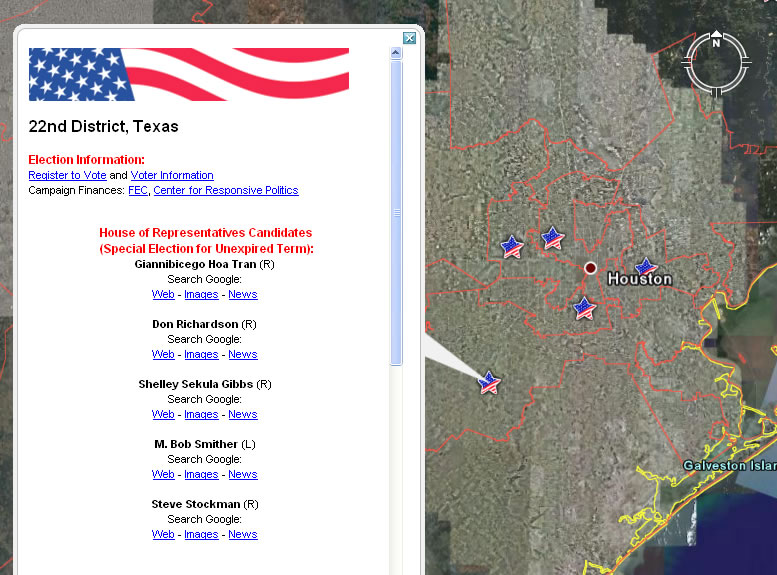
Google has just added a bevy of election information to its fantastic Google Earth product.

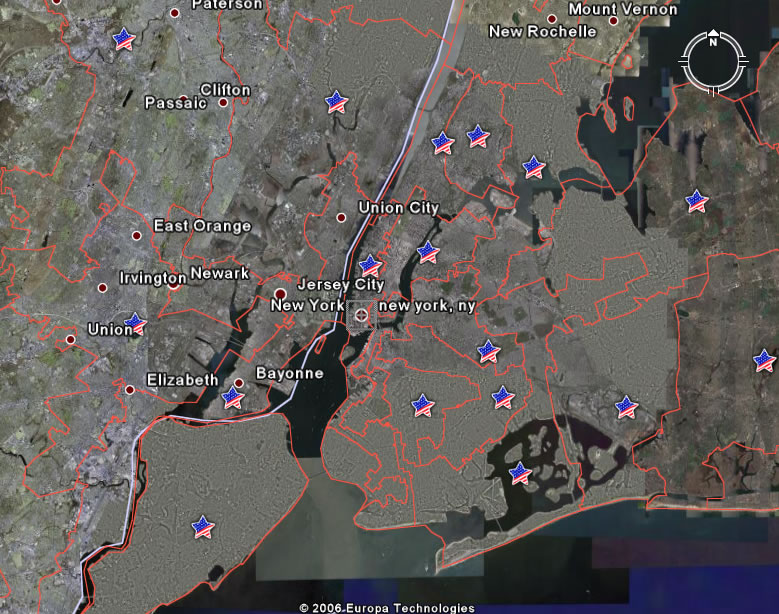
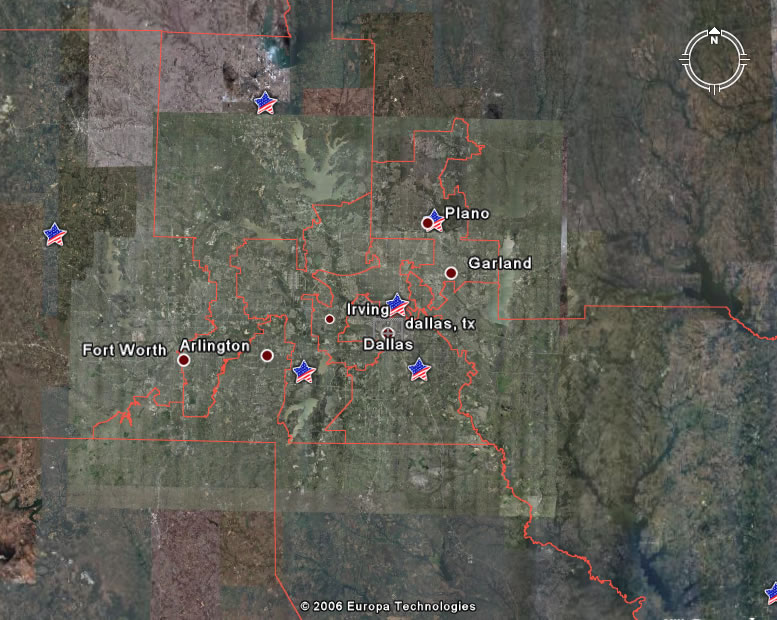
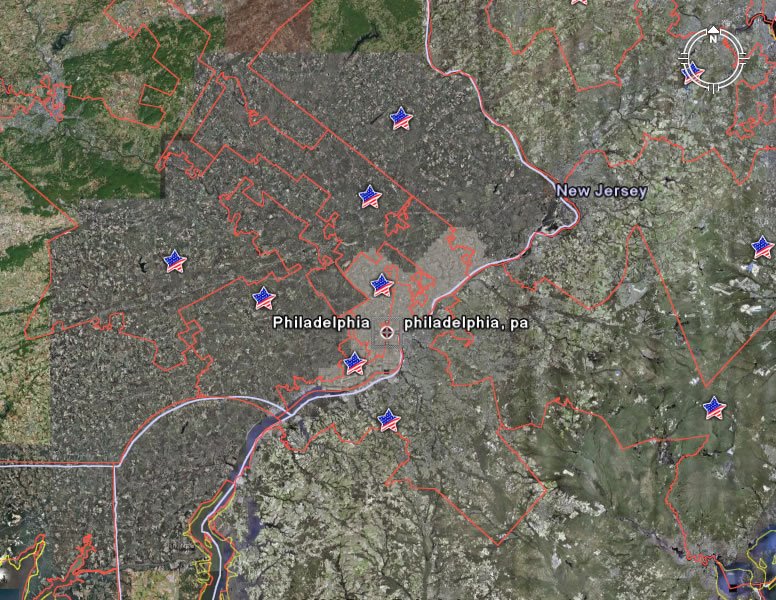
Users of Google Earth will notice a new layer called "2006 US Election Guide." Once activated this layer displays red lines to indicate our various Congressional districts, along with information regarding candidates purusing these seats this November.

Below is a snapshot of those candidates pursuing Tom DeLay's vacated 22nd District, Texas seat.


Far more interesting than the information available about candidates is this easy birds-eye view of the gerrymandering that has captured our system. Click on any of the cities below to see the monsters that Safe Seat congressional districting has created:


Los AngelesNew York City

Dallas/Ft. WorthPhiladelphia

You can download Google Earth for free here.

Thanks, Don!

Labels: , ,

Wednesday, September 27, 2006

Geoff Stone visits the CLS ACS

Professor Geoffrey Stone, of the University of Chicago, addressed ACS and students at Columbia Law School this afternoon. His topic was the Bush Administration's response to The New York Times story on National Security Administration surveillance. The Bush administration suggested that the Justice Department look into criminal actions against several parties involved in leaking the classified information in the story. Stone identified three types of parties implicated in the pursuit of this type of criminal action: first, government employees who leaked classified information (defined as any information that threatened national security); second, the journalists who obtained the classified information; and third, the publishers who disseminate that information.


Stone found a conflict between the treatment of the government employee, who can be prosecuted for leaking the information, and the publishers, who are protected under the First Amendment for printing it - unless the publication creates a clear and present danger. Stone then rationalized the conflict, first by pointing out that prosecution of state employees for this type of offense does not generally raise a full weighing of First Amendment issues. He then pointed to an overlooked element of hypotheticals in which the press can be prosecuted for publishing classified information. Such hypotheticals include publication of military ship departure dates, or of invasion plans, and are generally described as creating clear and present danger. However, Stone also proposed that such information does not contribute to public discourse, and that the press is only protected under the First Amendment for publishing any information that contributes to public debate. Thus, he says, the double standard - the application of disperate doctrine to the state employee and the press - disolves.


However, the journalist is left in a murky middle area. Stone pointed out that any way a journalist receives classified information is likely to be in itself a crime; bribery, solicitation of the leak (thus inciting a crime), or even mere passive receipt of illegally leaked information. Stone left the audience with the questions of where to draw the line between what would and wouldn't be an illegal way to obtain information, and also of who can be considered a journalist for the purposes of First Amendment protection. A lively conversation ensued after Stone's remarks, and the Columbia Law School ACS would like to thank Professor Stone for his thought-provoking and informative address.

Labels: , ,

Monday, July 24, 2006

ABA to Executive Branch: "The Constitution is not what the President says it is."

An ABA task force is urging Congress to pass legislation permitting court review of presidential signing statements.

Although the Justice Department claims that President Bush has only issued 110 signing statements (to Clinton's 80 such statements), the ABA task force cites research that Bush has challenged the constitutionality of 800 provisions of law passed by Congress.

Labels: , ,

Saturday, April 08, 2006

U.S. News Law School Rankings: The Harriet Miers Effect

Although it did not surge forward as much as University of Denver's Sturm School of Law (from #95 to #70) or Seton Hall (from #83 to #70), Harriet Miers's JD alma mater, the Southern Methodist University, tied for 3rd largest positive gain in the rankings, moving up 9 slots from #52 to #43.

2007 U.S. News Rankings
2006 U.S. News Rankings

Click here to view older rankings.

Labels: ,