Monday, February 04, 2008

A Toast to the Constitution: Temperance, A Benevolent Creator/Brewmaster, Happiness & Avoiding the Gout

Here's the toast from the 222nd Annual Constitutional Law Mixer, held at Columbia Law School on February 4, 2008. As in years past, the event was jointly hosted by the local chapters of the American Constitution Society, the Federalist Society, and the Constitution Law faculty here at Columbia.

First, I want to thank ACS & FedSoc for inviting me to give a toast at the 222nd Annual Constitutional Law Mixer. It's an honor to be a part of a tradition that predates both interchangeable parts and modern plumbing.

As Chancellor Kent was known to say: "Our annual Con Law Mixer? Yeah, that's kind of a big deal."

Back in May of last year, I stumbled across Robert Harris's review of the Barbara Holland book The Joy of Drinking. In Harris's review, he noted Holland's research into the role alcohol played in the creation of the United States Constitution. Harris writes that:
[I]n 1787, two days before their work was done, the 55 delegates to the Constitutional Convention “adjourned to a tavern for some rest, and according to the bill they drank 54 bottles of Madeira, 60 bottles of claret, 8 of whiskey, 22 of port, 8 of hard cider and 7 bowls of punch so large that, it was said, ducks could swim around in them. Then they went back to work and finished founding the new Republic.” Note the 55 delegates and 54 bottles of Madeira. Which founder was slacking?
PG, a recent CLS graduate and the only person I know whose Constitutional leanings led her to be an active member of both ACS and the Federalist Society, speculated that Thomas Mifflin – at the time the sitting President of Pennsylvania and a Quaker prior to his expulsion for serving in the Continental Army – was the teetotaler; however, given the amount of drink involved, it's unsurprising that the identity of the true abstainer would be lost to history.
Perhaps it was the drink, but there's so much about the Constitution that's been lost to history, so much that the Founders forgot to tell us about the meaning and the crafting of this founding document:
  • Dear Founders, is that a comma, a semi-colon, or a fleck of dirt?

  • O Breech-pants-wearing Founders, is the office of the Vice President firmly seated within the executive branch, or is it an extra-constitutional floater, like the extra outfielder in a game of slow-pitch softball?

  • O Founders, did you really believe that human nature would permit the loser of the Presidential election to serve as a good Vice-President to the winner?

  • Founders, why-oh-why did you decide to capitalize nearly every noun in the Constitution? ...and what's the deal with the handful you didn't capitalize? (...and 1L's: That's a gangbuster note topic, by the way.)

  • O Founders, are there secret messages in your tortured and inconsistent spellings?
Ultimately, we just don't know the answers to any of these vital questions, so we're left to make like the founders and drink a little Madeira, claret, whiskey, port and hard cider — maybe that will bring some clarity. (Incidentally, I was told that this event would have a bowl of punch so large that ducks could swim in it. Maybe that's coming later.)

In finishing my toast and finally raising a glass, I want to end with a meditation.

Let's meditate upon how the Constitution would have looked if Ben Franklin had had more creative control over the text. After all, historians report that when Thomas Jefferson sent Franklin a draft of the Declaration of Independence containing the line "We hold these truths to be sacred and undeniable," Franklin returned it to him with the last three words crossed out and replaced by "self-evident." Surely the person responsible for this memorable and meaningful term into the Declaration of Independence could have helped us more with the Constitution. (By the way, for those of you who are measuring the productivity of your lives against the lives of the Founders or choosing your political candidates on the basis of age, please note that Thomas Jefferson was all of 33 years old when he helped draft the Declaration of Independence.)

Now, I happen to know what Franklin would have done if he'd had his way with our overly short & oft-confusing Constitution. He would have included two final clauses.

In fact, I know which clauses Franklin would have inserted.

Truth be told, I find the tension between these two clauses to be roughly analogous to the on-going dialogue that occurs between the Federalist Society & ACS.

The first clause is a quote of Franklin's, taken from Poor Richard's Almanack, 1734. To me, this is the Federalist Society clause: "Be temperate in wine, in eating, girls, and sloth, or the gout will seize you and plague you both."

The second clause does not appear in any published writing of Franklin's, but has been broadly attributed to him. Naturally, the lack of textual basis for this quote (and its feel-good character) makes it more appropriate for ACS. The clause is: "Beer is proof that God loves us and wants us to be happy."

So please join me in raising a glass: Here's to Franklin, to the other Founders, to their strange and wondrous Constitution, to ACS, to the Federalist Society, to being happy, and – above all – to trying our best to avoid the gout.

CHEERS!

Labels: , ,

Thursday, September 13, 2007

The President's Pen: Negating Congressional Initiative and Hampering Effective Policy

The presidential signing statement is not new. Its been around for a long, long time, but the frequency with which this President has employed it is staggering. Between 1817 and 1981, only 75 such statements were issued from the White House. As of June 2006, President Bush had issued over 600. (For an excellent overview of Bush's use of signing statements, www.beyondpartisan.org). It is true that Presidents Reagan and Clinton issued signing statements at a far greater rate than their predecessors, this executive has implemented the form for the purposes of participating in a purely legislative process: the determination of what issues federal legislation should address.

This is what bothers me most about President Bush's use of the signing statement. He is effectively telling Congress, "I understand that you have identified a social problem, but I disagree with the means you chose to address is (or perhaps that it is a problem at all). Thus, I will abandon my Constitutional duty of implementation, because you, vox populi, are talking jive."


It's fun to eviscerate democracy!

The first signing statement issued by President Bush is illustrative of this point. Congress, in passing the Animal Disease Risk Assessment, Prevention, and Control Act, instructed the Secretary of Agriculture to provide reports including legislative recommendations on various issues of animal disease prevention. President Bush's signing statement objected to Congress' temerity in telling his employee what to do. The merit of the administration's fundamental separation of powers argument here is beyond my capacity or present interest to assess, but this example is telling on a more basic level.

Here, Congress has responded to widespread public apprehension about diseases carried by animals and their potential communicability to humans or impact on the food supply. (Remember Avian Flu?) The President - whether or not he agreed that this was an important problem with a role for the federal government in tackling it (it looks like he did, given that his CDC has been training to deal with a potential Avian Flu pandemic) - squelched a useful avenue for the provision of valuable scientific expertise to the Legislature for reasons boiling down to a juvenile bureaucratic turf war. Congress saw a problem, realized it needed expert assistance to effectively legislate against it, and asked for that aid. President Bush ignored the public good, legislative and popular mandate, and the quest for effective policy solutions.

Perusing the index of signing statements published by ACS (pdf) is an interesting and frustrating endeavor. The exercise also reveals that President Bush has used signing statement to usurp judicial - in addition to legislative - powers. In many cases, the administration's reason for issuing a signing statement is that the particular provision at issue contravenes a constitutional provision or the Supreme Court's interpretation thereof. (Very often the signing statements invoke INS v. Chadha as prohibiting post-enactment participation of Congress in implementation decision-making).

While all government actors should consider the constitutionality of their actions at all times, the supreme arbiter of constitutionality is the Supreme Court (see e.g. Marbury v. Madison). This is especially true when applied to interpreting the Court's own precedents.

In the end, my overwhelming reaction to this important documentation of a little-known presidential tactic is quite blunt: I implore you Mr. President, KNOW YOUR ROLE. Let the Court and Congress to their respective jobs and you stick to the enduring inept execution of your own.

Labels: , ,

Wednesday, September 05, 2007

A Catalogue of Passed-But-Unenforced Legislation

Today, the national ACS website posted an interesting 229-page .pdf file. It's an index of all the Presidential Signing Statements issued between 2001-2007.

Although not specifically permitted or prohibited by the Constitution, signing statements provide notice how a President intends to enforce a law. According to the file on the ACS website, President Bush has used signing statements to lodge 1,047 objections to legislation signed into law.

Labels: ,

Monday, June 25, 2007

Drama Chipmunks/Prairie Dogs & the DMCA

I've divided this post into two parts for the benefit of those of us whose love of the internet does not translate into an appreciation of US internet law. Part I discusses a dramatic rodent capturing the attention of the internet. Part II discusses the law surrounding this rodent.

Part I: Dramatic Rodents on the Internet

The 5-second video below was originally titled "Drama Chipmunk" (I guess it's actually a prairie dog) and appeared on YouTube a little over five days ago:


(In case you're reading this post sometime after, say, July 1, 2007, I suspect that the clip will be removed — for reasons that are described in the law section below. If the video link doesn't work, Google the title of the clip you will find it.)

Since then, this dramatic little beast's performance has been viewed by more than 500,000 people. It has inspired a t-shirt. It has spawned numerous imitations and parodies, many of which are hilarious.

...it may or may not be on YouTube illegally.


Part II: The Law of Dramatic Rodents on the Internet (5-minute version)

When I first saw the Drama Chipmunk/Prairie Dog, I suspected that it was one of the few videos posted to YouTube where the person posting the video actually had done so legally.

There are 2 kinds of videos that can be legally posted on YouTube. For all the other kinds of videos on YouTube – where the posting of the video is illegal under U.S. copyright law – there is a specific law designed to keep the YouTubes of the world out of trouble (even if the people actually posting the videos may themselves get in a little trouble).

Legal YouTube Video #1 — The Person Publishing the Video Has the Right Set of Sticks: In every property law course taught in America during the past 100 years, the professor has at some point said, "property is a bundle of sticks." Although the rights underlying U.S. copyright law differ slightly from the rights underlying property ownership, the sticks metaphor holds up: Depending on the circumstances, you might have the right set of sticks, you might not.

Some of the videos you see on YouTube are legal because the person publishing the video is the copyright owner with the right to display and/or distribute the video. When you see guys destroying an old car with a 500-lb ball of rubber bands or free running through the streets of Russia, you're watching a video where the person who shot the video is probably the same person who edited the video for web-distribution, and is probably the same person who uploaded it to YouTube. In this case, it's extremely likely that the person has the right to post the video online.

Legal YouTube Video #2 — The Person Publishing the Video is a Fair User: Under the U.S. Constitution, copyright law protects original works "[t]o promote the Progress of Science and useful Arts," not to make content creators rich. As such, the rights protected by copyright can be limited for a variety of purposes.

The largest limit on an owner's copyright in the United States is something called Fair Use. This doctrine permits an unauthorized person to use someone else's work in a manner that is fair, usually a use that contributes to society in some (modestly) beneficial way without taking too much money out of the original author's pocket through a lost market. In 1976, the Congress formally enacted a statute governing fair use (17 U.S.C. § 107), adopting judge-created language that had been in use since the 1840's:
. . . the fair use of a copyrighted work . . . for purposes such as criticism, comment, news reporting, teaching . . . , scholarship, or research, is not an infringement of copyright. In determining whether the use made of a work in any particular case is a fair use the factors to be considered shall include—
  1. the purpose and character of the use, including whether such use is of a commercial nature or is for nonprofit educational purposes;
  2. the nature of the copyrighted work;
  3. the amount and substantiality of the portion used in relation to the copyrighted work as a whole; and
  4. the effect of the use upon the potential market for or value of the copyrighted work.
Fair use is a tricky one. It lets 2 Live Crew perform Pretty Woman without Roy Orbison's permission, but it doesn't permit a magazine to print (without authorization) a book's bombshells about Nixon before that book has been published, nor does it let a television show display an artistic poster on TV without permission from the poster's creator.

Well, the creator of Drama Chipmunk/Prairie Dog (which I'm going to abbreviate as DCPD) probably doesn't own the rights to post it online. Earlier today, I learned that DCPD was taken from a Japanese TV show, almost certainly without the permission of the copyright holder. (Foreign copyright holders have a U.S. copyright to their works at the moment of creation. There's no registration required.) Taking a current TV show without permission and displaying it on the internet? That's a prima facie case of copyright violation, and the creator of DCPD will be on the hook for copyright violation unless DCPD constitutes a fair use.

This armchair judge is certain that DCPD is a fair use. Under the statutory test quoted above, it will win the battle of the prongs (Under the purpose and character test it will be considered transformative, although the TV show owner will win the second prong, the third and fourth prongs will lean heavily in Drama Chipmunk/Prairie Dog's favor). Still, it's a close call, and it's a call that internet remix artists are not aware of when they remix culture online.

How YouTube Stays in Business with People Posting Videos that Violate U.S. Copyright: Since even something as short, innocent, and – in the language of fair use – transformative as DCPD is a close call, it should be obvious that violating videos are posted to YouTube all the time. Here's how the law of posting copyright-violating videos to YouTube works.

Congress passed a wide-ranging law in 1998 called the Digital Millennium Copyright Act (which everybody calls the "DMCA"). If you talk to people who share online music, you've probably heard them complain about the DMCA — but the section of the DMCA that they're complaining about, Title I, has literally nothing to do with the section we're going to talk about, Title II. Title II is kinda cool.

Without Title II, YouTube would not be in business. Before Title II, YouTube would be contributorily and/or vicariously liable every time a user posted a video that violated copyright and a lawsuit was filed against that user and YouTube. Title II (which is now 17 U.S.C. § 512) creates a "safe harbor" for services like YouTube. Paragraph 512(c) eliminates YouTube's liability — unless a user's content is obviously a violation of copyright (DCPD is not an obvious violation) and as long as YouTube cooperates with copyright owners who demand that YouTube remove content violating their rights, YouTube can wait until those copyright owners complain before they remove content that violates copyright.

Under the current interpretation of 512(c), YouTube is in the clear; however, as more and more copyright owners see their rights violated on YouTube, they'll continue to exert pressure on the U.S. court system to tweak the interpretation of 512(c) into one that is less favorable to YouTube and other Web 2.0 businesses.

Under paragraph 512(c)(1)(a)(ii), YouTube would get in trouble if it let a user post content that was clearly violative of copyright. Previous courts have stated that user-posted content would need to set off bells and whistles to meet the obviously illegal standard: Something titled HERE'S AN ILLEGAL VIDEO THAT I STOLE FROM THE RIGHTFUL COPYRIGHT OWNER would probably meet the standard. However, earlier this month the 9th Circuit Court found that two websites — one entitled illegal.net and the other named stolencelebritypics.com — did not meet the standard whereby the company hosting the sites should have known that "infringing activity [was] apparent." I strongly suspect we'll see what the Supreme Court says about that assumption.

Until then, YouTube's business plan is safe, video remix artists will continue to remix culture and post it online, and a certain Drama Chipmunk/Prairie Dog will continue to captivate us with his/her penetrating gaze.

Labels:

Sunday, March 04, 2007

“A Separate Society”

Judicial deference, separation of powers, and Harrison Ford

On the bus ride to Boston for the Don’t Ask Don’t Tell conference hosted by HLS Lambda, I was forcibly treated to Harrison Ford’s invigorating defense of the Constitution in Clear and Present Danger. The movie was remarkably apt for the occasion, and two spot-on moments of melodrama managed to sneak in between the bullets and the bombs. When Harrison Ford (aka Dr. Jack Ryan, acting CIA deputy director of intelligence) first discovers a miniature undeclared war in Colombia authorized by the President, his boss tells him, “You took an oath…I don't mean the President. You gave your word to his boss: you gave your word to the people of the United States.” At the end of the movie, Ford leaves the President in the Oval Office with a look of utter scorn and testifies for the Senate Intelligence committee, apparently the arbiters of justice in the Tom Clancy world.

So what happens when the political branches are more or less united? Is it the place of the courts to question the judgment of the elected representatives of the people over the constitutionality of their policies? The answer is always and emphatically yes. Don’t Ask Don’t Tell is no exception, and as the conference panelists made clear, the Supreme Court needs to apply strict scrutiny to this discriminatory policy.

Professor Tim Bakken outlined the usual legal justifications for judicial deference to the judgment of Congress and the President:
  • a textual argument for granting the political branches power and authority, especially when they are in concurrence,

  • an argument of standard deference to Congressional fact-finding,

  • and an argument for deference to military findings and decisions as the expert in the field.
However, none of the legal justifications are the true reasons for Don’t Ask Don’t Tell because they reference the argument that DADT is necessary to preserve unit cohesion and military morale, an argument so flimsy even the Defense Department has backed away from it in recent years. Former service members told emotional stories explaining that rather than improving cohesion and morale, DADT caused harm by making them feel unwelcome and dishonorable. Professor Laurence Tribe encapsulated the crucial problem with DADT: it is based solely on the military’s discomfort with homosexuality. Discomfort is not a legal or constitutional justification.

Despite the current tendency towards judicial deference with regards to Don’t Ask Don’t Tell, the Supreme Court still has the power to act. As several of the panelists emphasized, deference does not equal abdication. The Court has deferred to military judgments on the importance of military interests and values, but DADT clearly does not fall within the logical scope of deference to the military. Even with judicial deference to Congress and the President, the constitutional standard of strict scrutiny does not change. That means the Court must find a compelling government interest which can only be served by DADT. The stated compelling interest and the “tailoring” or fit of DADT are both highly questionable.

Stuart Delery, currently representing a group of discharged service members in Cook v. Gates, is championing the argument that judicial deference operates within the Constitution, not as a replacement. Likewise, the military must operate within the limits of the Constitution. As Professor Tribe thundered into his microphone, the military is not a “Constitutional blackhole.”

Labels: , ,

Wednesday, February 28, 2007

You, Yes, You Own the Military, So Help Fix It

Today’s Don’t Ask Don’t Tell panel consisted of two lawyers from the Servicemembers Legal Defense Network (SLDN) and two former military officers.

The panel began with an overview of the current effects of the Don’t Ask Don’t Tell policy (10 U.S.C. § 654). The Don’t Ask part of the statute prevents the military from asking about sexual orientation when someone joins. However, once in the military, a gay service member must constantly guard his words and actions or suffer the consequences of being outed to his superiors. 11,000 service members have been discharged since the policy was enacted in 1993, with an average of 2 discharges per day.

The two service members on the panel gave a personal view of the DADT policy at work. Cholene Espinoza spoke about remaining in the military while hearing about other service members who were discharged for being gay. Having taken the military oath not to lie, steal or cheat, nor tolerate others who do, Espinoza acknowledged the deep irony that in order to remain an officer, she was forced to lie about her own identity as a lesbian. Because of the DADT policy, Espinoza called the military “broken.”

“You own it,” said Jeff McGowan, reminding the audience that all Americans have the capability and responsibility of pushing the military to change its discriminatory policy. The Constitution, after all, placed the military under the authority of a civilian government of the people, and that remains equally true today.

McGowan also pointed out in response to a student question that the military is using the same arguments against allowing openly gay service members as were used to oppose the integration of blacks into the military. Those arguments are only a pretext for discrimination. Many countries have openly gay service members, including Britain and Israel, disproving the argument that Don’t Ask Don’t Tell is necessary for the unity and morality of the American military.

The DADT policy is being challenged in the courts on the grounds that it violates the substantive due process and equal protection clauses of the Constitution and suppresses First Amendment rights. In Congress, there are more than 100 cosponsors for the Military Readiness Enhancement Act (H.R. 1059), a bill seeking to repeal Don’t Ask Don’t Tell.

In addition, the fight continues against the Solomon Amendment (10 U.S.C. § 983) despite the recent Supreme Court decision upholding its constitutionality (Rumsfeld v. FAIR). The Solomon Amendment threatens to withdraw federal funds from any university that prohibits military recruiting. In essence, it silences universities, preventing them from expressing their disapproval of the military’s DADT policy, a questionable use of the Congressional spending power.
(More on this subject after this weekend’s GALLA conference at Harvard Law School.)

Labels: ,

Monday, February 12, 2007

Nixon Coin Enthusiasts Will Have to Wait

New U.S. dollar coins featuring former Presidents go into circulation this week. The coins will feature the Presidents in order, 4 per year.

Unfortunately for Nixon enthusiasts, this means that the 37th President of the United States will not grace a $1 coin until 2016.

Labels: ,

Wednesday, January 24, 2007

A Toast to the American Constitution Society, the Federalist Society, and the Agreed-upon Constitution

By popular demand, here's the toast from the Columbia Law School's ConLaw Mixer, held on January 23, 2007. The event was jointly hosted by the local chapters of the American Constitution Society, the Federalist Society, and the Constitution Law faculty here at Columbia.

When ACS President Jon Sherman asked me to say a few words for this event, I initially thought I’d focus on the differences in how the American Constitution Society and the Federalist Society approach the Constitution.

I mean, every ACS member knows that the members of the Federalist Society look longingly at the days before pasteurization — that they fancy themselves as yeoman farmers on the New Jersey frontier where they dream of a world in which interchangeable parts will someday be a reality.

Similarly, every FedSoc member knows that when the members of the American Constitution Society hear someone talking about "penumbras formed by emanations," they promptly instruct the bartender that they’ll have what that guy’s having.

. . . but these differences are minor. Today, let’s celebrate the similarities — of which there are many. I’ve spent the past couple days pouring over this document, locating areas of significant agreement. I’ve found three areas of broad agreement about the Constitution. Interpretations upon which we can all agree, areas that we can all toast.


AREA #1: We agree on the many of the powers assigned either to the states or the various branches of our federal government.

What does this mean?

For the States, we shall not rest until states stop granting Letters of Marque and Reprisal and until they stop granting Titles of Nobility. We insist they settle their past debts using gold or silver.

For the Congress, we demand that it not shirk its duty to establish post Roads, to erect needful Buildings in D.C., and — as stated in Article 1, Section 5, clause 2 and reiterated the 20th Amendment — that it meet at least once every year.

For the Judiciary, we insist it remain vigilant to the needs of justice, that it insure no Attainder of Treason work Corruption of Blood, and that no one shall not be convicted of Treason without a rigorous trial consisting of at least 2 witness presenting evidence against her.

Most importantly, we ask that the judiciary fully enforce the 11th Amendment, whether that amendment actually means what it says . . . or whether actually every word of that amendment means the exact opposite of what it appears to mean.

Finally, concerning scope and appropriate exercise of Executive power, we… you know what, let’s just move on to Area #2.


AREA #2: I know I speak for everyone in this room when I say we supports the passage of the original 1st Amendment — the Congressional Apportionment Amendment.


As many of you know, on September 25, 1789 the 1st Congress introduced 12 — not 10 — amendments to the states as the Bill of Rights.

The original 2nd Amendment — barring Congress from granting itself immediately effective pay raises — became the 27th Amendment on May 20, 1992. However, the original 1st Amendment was only ratified by 11 states — 2 shy of passage at the time. Since Coleman v. Miller makes clear that all amendments are considered pending before the state indefinitely unless Congress establishes a deadline within which the states must act, only 27 states are now needed to ratify this amendment for its passage. Hey 27 states, pass the original 1st Amendment.

If passed, the Congressional Apportionment Amendment would establish guidelines for the size of the House of Representatives. The Amendment’s math is a little hazy, but it ends with this important instruction: "there shall not be . . . more than one Representative for every 50,000 persons."

With a present US population of more than 300 million people, this introduces the possibility of a 6,000-member House of Representatives. I know I speak for everyone here when I say that if there’s one thing that the august body of the House needs to be truly effective, it’s to have 5,565 members added to its ranks.


In closing, Area #3 is really a pledge:

AREA #3: We pledge from this day forth that we shall write like the authors of our Constitution.

Not only shall we employ capitalization seemingly at random and use either British, tortured, or inconsistent spelling whenever possible, but — like the Constitution’s signatories — we shall sign our name to documents using absurd abbreviations.

I mean, why grace the document with your full name — it’s only a Constitution? These people, these founders, signed the Constitution with all the formality of someone signing a traffic ticket. William Blount went with the predictable "Wm." but William Livingston chose the path of a hipster, abbreviating "Wil:" Jonathan Dayton became "Jona:" Robert Morris became "Robt." . . . and anyone who has studied with Professor Hamburger will know who I’m talking about when I tell you that one of them merely signed "Gouv."

5 of the signatories determined that their signatures constituted little micro-sentences, worthy of ending with a period. We, too, shall end our signatures with periods. From this day forward, if you see a document signed "And: Brad:." know that it is me.


As you can see folks, our points of agreement are broad and substantial. So here’s to our agreements and our differences, here’s to our faculty and our constitutional societies, and here’s to the wig-and-tight-pants-wearing founders who made it all possible. Cheers!

Labels: , , , , , ,

Tuesday, December 05, 2006

When It Says Religious Test, It Doesn't Mean Test Like the S.A.T.

The American Family Association – worried that newly-elected Representative Keith Ellison (D-MN), who happens to be Muslim, will be sworn in with his hand on the Koran (instead of the Christian Bible) – is urging its members to do the following:
  1. Send an email asking your U.S. Representative and Senators to pass a law making the Bible the book used in the swearing-in ceremony of Representatives and Senators.

  2. Forward this email to your friends and family today!
Never mind that Representatives don't place their hands on anything when they're sworn in en masse. How the AFA-proposed law wouldn't violate Article VI, Section 3 is beyond me:
The Senators and Representatives before mentioned, and the members of the several state legislatures, and all executive and judicial officers, both of the United States and of the several states, shall be bound by oath or affirmation, to support this Constitution; but no religious test shall ever be required as a qualification to any office or public trust under the United States. (emphasis added)
Too many more oversights like this and I'm going to stop turning to the American Family Association for my constitutional theory.

Labels: ,

Thursday, November 23, 2006

If I Include "Second Amendment" in the Title of My Bill, Does that Make it a Proposed Amendment?

There are many reasons for Congress to consider legislation. One of the primary reasons for Congress to consider legislation is that it believes that the judiciary will not find the subject matter of the statute already protected by the Constitution.

Last Thursday, Lame Duck Virginia Senator George Allen proposed SB 4057, tentatively titled The National Park Second Amendment Restoration and Personal Protection Act of 2006. According to the current description of the bill, it would "protect the second amendment rights of individuals to carry firearms in units of the National Park System." If passed, it would permit a properly licensed individual to carry a concealed weapon in a National Park.

Of course, the bill's title and short description do nothing other than to obscure the bill's point and confuse debate. The Second Amendment doesn't grant you the right to carry a concealed weapon in the National Park System. That's why you're proposing this law.

Labels: ,

Monday, October 23, 2006

Google Earthy-mander

Google has just added a bevy of election information to its fantastic Google Earth product.

Users of Google Earth will notice a new layer called "2006 US Election Guide." Once activated this layer displays red lines to indicate our various Congressional districts, along with information regarding candidates purusing these seats this November.

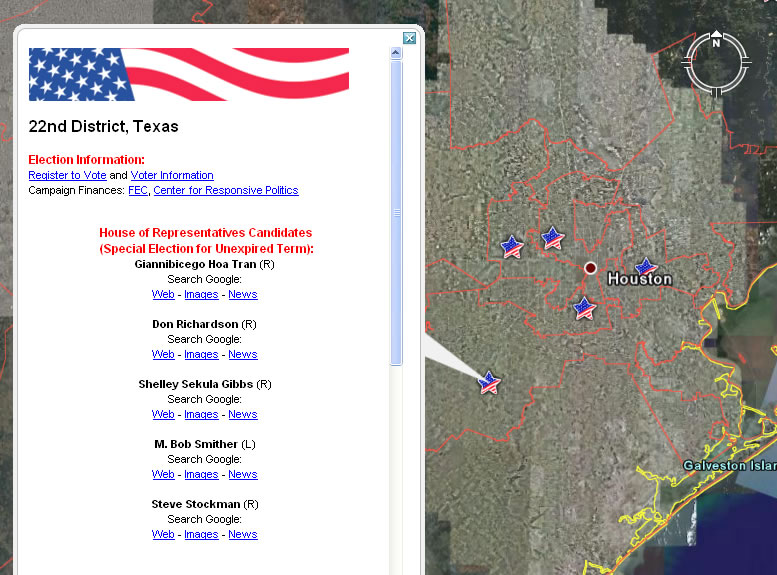
Below is a snapshot of those candidates pursuing Tom DeLay's vacated 22nd District, Texas seat.


Far more interesting than the information available about candidates is this easy birds-eye view of the gerrymandering that has captured our system. Click on any of the cities below to see the monsters that Safe Seat congressional districting has created:


Los AngelesNew York City

Dallas/Ft. WorthPhiladelphia

You can download Google Earth for free here.

Thanks, Don!

Labels: , ,

Tuesday, October 17, 2006

Advice & Consent & Judge Janet T. Neff

Senator Sam Brownback (R-KS) is blocking the confirmation of Bush-nominated Judge Janet T. Neff, who currently sits on the Michigan Court of Appeals.

Senator Brownback's reason for holding up her nomination? Well, it seems that Judge Neff once attended a commitment ceremony for a lesbian couple.

Labels: ,

Tuesday, October 03, 2006

Gay Rights as the Cause of “Naughty Emails”?

By now, we’ve all heard about the inappropriate, lurid conversations, instant messages, emails, and possibly encounters of now-former Rep. Mark Foley, R-FL. The scandal has raised significant issues about accountability in Republican leadership and the oversight of the page problem in general. But many conservatives have been quick to characterize the problem differently- as one of an inherent problem with homosexuality, and in particular, a problem resulting from the granting of gay rights. Rather than seeing Mr. Foley as a troubled man, living in the closet (though he was outed in gay media in 1997), and abusing his power in a completely inappropriate way, members of the right wing are holding up Mr. Foley as an example of all gay men- and furthering the baseless accusation that gays are more likely to pursue relationships with children.

On one prominent right-wing blog sponsored by the inappropriately named “Accuracy in Media”, Editor Cliff Kincaid takes the media to task for not ascribing Mr. Foley’s behavior to his homosexuality, and takes the Republican Party to task for “protecting” Foley’s homosexuality, which he calls a perversion. The veritable Family Research Council has gone even further, saying that “Pro-Homosexual Political Correctness” is to blame for Rep. Foley’s behavior, saying that political correctness (or what we refer to as basic human rights and dignity) has come at the expense of child safety.

Disappointingly, these myths are being propagated by usually more reasonable right-wingers. The Wall Street Journal editorial page is claiming that Rep. Foley’s actions gives credence to the Boy Scouts of America’s anti-gay discriminatory policy. Ben Stein, former host of “Win Ben Stein’s Money” and Nixon Administration official, writes in the American Spectator, “I hope it won't come as a surprise to anyone that a big part of male homosexual behavior is interest in young boys.”

As a practicing male homosexual, I will be honest- it surprises me. Homosexuals, like heterosexuals, have a wide range of tastes in sexual partners. To say all male homosexuals have an “interest” in young boys is as absurd as saying all male heterosexuals have an interest in retired senior citizens from South Florida. Others are saying that the fact that Rep. Foley found 20-year old men attractive should have been signs of trouble. Many older heterosexual men find 20-year old women attractive—that doesn’t mean they’re pedophiles. The double standard is fairly clear.

Stein also argues that LGBT individuals aren’t expressing their support for Rep. Foley as they have for other gays involved in scandals. But there is a difference between supporting someone’s homosexuality and ability to openly express it, and supporting their inappropriate behavior. Had Rep. Foley simply “come out”, he surely would have had as much support as any other politician who has decided to cease hiding his sexuality.

If anything, the continued repression and subordination of LGBT Americans likely had a greater influence on Mr. Foley’s behavior than “political correctness.” I do not condone Mr. Foley’s behavior in any way, but the fact that Mr. Foley’s homosexuality is part of the “news” at all is a sad commentary on the state of affairs in this country. If the circumstances of his affair were exactly the same, but merely concerned female pages instead of male pages, Mr. Foley’s behavior would have been as inappropriate and unacceptable. However, the sad truth is that the scandal would likely be considered more forgivable if the pages involved were female.

The only sympathy that Mr. Foley deserves today is due to the fact that he could not be openly gay throughout his tenure as a legislator. (Currently, there are only 3 openly gay members of Congress- .6%) In fact, when rumors started swelling around his 2003 Senatorial run, he left the race rather than admit that he was a gay man- facing the choice between being himself openly and his career- a choice that too many LGBT Americans face daily. To save face, Mr. Foley even went so far as to say “I like women…” and call it "revolting and unforgivable" that people were openly speculating that he was gay.

The good news is it seems unlikely that the majority of Americans will buy the argument that treating LGBT Americans with respect, dignity, and the equal protection of the laws “caused” Mark Foley’s immoral, condemnation-worthy behavior. Mark Foley’s inappropriate behavior towards pages cannot be used to justify discrimination towards LGBT Americans. LGBT Americans deserve to be treated with equal rights, and Mr. Foley’s actions are condemnable regardless of his sexual orientation. If anything, Mr. Foley’s inability to live openly as a gay man should remind us of the need to protect LGBT Americans, not rollback their civil rights.

Labels: ,

Monday, July 24, 2006

ABA to Executive Branch: "The Constitution is not what the President says it is."

An ABA task force is urging Congress to pass legislation permitting court review of presidential signing statements.

Although the Justice Department claims that President Bush has only issued 110 signing statements (to Clinton's 80 such statements), the ABA task force cites research that Bush has challenged the constitutionality of 800 provisions of law passed by Congress.

Labels: , ,

Friday, April 14, 2006

Monday! Capitol Hill Staffers on Careers on the Hill and the Judicial Nomination Process

Social Justice Initiatives' Government Speaker Series

Monday, April 17
Jerome Greene 102
4-5 P.M. & 5-7 P.M.


Senior lawyer staff members of the US Senate Judiciary Committee from both sides of the aisle will be at Columbia on April 17th for two programs.


Preet Bharara – Senator Schumer (D, NY)
Helaine Greenfeld – Senator Leahy (D, VT)
Pete Jensen – Senator Spector (R, PA)
Jonathan Meyer – Senator Biden (D, DE)
Ajit Pai - Senator Brownback (R, KS)


Careers on the Hill
4-5 P.M.
Curious about what Congressional staffers do?
Interested in a summer or postgrad job?
This panel will provide answers to your questions.
Moderated by Dean Ellen Chapnick


Roundtable on the Federal Judicial Confirmation Process
5-7 P.M.
A thoughtful bipartisan exploration of the various needs served by the Constitutionally mandated procedure for appointing and confirming federal judges, the current process and alternatives that might be more useful and appropriate.
Moderated by Professor Gillian Metzger.


Co-Sponsered By
the Center for Public Interest Law,
the Columbia Chapter of the American Constitutional Society,
and the Columbia Chapter of the Federalist Society.

Labels: , ,

Monday, March 13, 2006

Illinois Senate Bill 2724: An Irrelevant Electoral College? (Part II)

(For Part I of this story and Andy's personal beef with the electoral college system, click here.)

Instead of personally characterizing Illinois Senate Bill 2724, I'll leave that task to Hendrik Hertzberg, who wrote about the bill for the New Yorker:
Here's how the plan would work. One by one, legislature by legislature, state law by state law, individual states would pledge themselves to an interstate compact under which they would agree to award their electoral votes to the nationwide winner of the popular vote. The compact would take effect only when enough states had joined it to elect a President — that is, enough to cast a majority of the five hundred and thirty-eight electoral votes. (Theoretically, as few as eleven states could do the trick.) And then, presto! All of a sudden, the people of all fifty states plus the District of Columbia are empowered to elect their President the same way they elect their governors, mayors, senators, and congressmen. We still have the Electoral College, with its colorful eighteenth-century rituals, but it can no longer do any damage. It becomes a tourist attraction, like the British monarchy.
The effort is called National Popular Election, and it has the support of The Center for Voting & Democracy, the leader in US election reform.

As the Per Curiam opinion in Bush v. Gore, 531 U.S. 98 (2000), notes, "the State legislature's power to select the manner for appointing electors is plenary; it may, if it so chooses, select the electors itself, which indeed was the manner used by State legislatures in several States for many years after the Framing of our Constitution." If this 6-year old statement even remotely reflects the current sentiment on SCOTUS, the National Popular Election effort would easily withstand constitutional scrutiny.

Here's hoping that enough states exercise this plenary power in such manner as to give voice to the will of the national electorate. The Illinois bill is currently in committee. Keep your fingers crossed. Your vote for the President may count soon enough.

Labels: , , ,

Illinois Senate Bill 2724: An Irrelevant Electoral College? (Part I)

Each State shall appoint, in such Manner as the Legislature thereof may direct, a Number of Electors, equal to the whole Number of Senators and Representatives to which the State may be entitled in the Congress.
Article II § 1.2
Growing up the son of two Democrats in the blood red state of Nebraska, I quickly developed a disdain for our electoral college system. Since Nebraska's electoral college votes have gone to the Republican candidate in every presidential election since Nixon in 1968, my parents' Democratic votes have never actually contributed to a winning candidate's total (never, except for my father's inexplicable 1972 Nixon vote, a ballot that will forever live in family infamy).


High school civics course arguments in support of the oft-criticized electoral college system generally cite the need to prevent the more populous states from luring Presidential campaign attention entirely away from less peopled states. (A final Nebraska anecdote: No system can prevent a state from falling off the map of a sitting President. Having previously visited the other 49 states, Nebraska was the last state visited by Bill Clinton during his presidency. Even then, he had to be lured into the state through the erection of one of the nation's sillier museums.)

But does this argument hold water? Hendrik Hertzberg points out in the New Yorker that the Presidential game (if ever fought in the small states) has moved to the battleground "purple" states:
In 2004, there were thirteen such states, accounting for twenty-eight per cent of the population (and thirty-two per cent of the ultimate vote, since turnout increases with the uncertainty of the outcome). In the final month, the candidates spent $237 million on advertising, $229 million of it in those thirteen states. (In twenty-three states, they didn’t spend a dime.) At the same time, President Bush, Vice-President Cheney, Senator Kerry, and Senator Edwards attended a total of two hundred and ninety-one campaign events. Two hundred and sixty-eight of them were in the lucky thirteen.
Even if arguments in favor of maintaining the electoral college status quo are less than compelling, the strongest argument that the electoral college system is here to stay has always been the difficulty in changing our system of electors. Amending the US Constitution to enable the direct election of the President would require a 2/3rd vote of both houses of Congress and then ratification by "three fourths of the several States."

As power shifts from party to party, neither side could be relied on to provide support consistent enough to clear this high hurdle for reform. As the New Yorker article notes, Bush may have been a big fan of the electoral college in 2000, when he became the first person since Benjamin Harrison to win the Presidency and lose the popular vote; however, he probably held the electoral college in considerably less esteem in 2004, when despite his clear margin in the popular vote, he nearly lost to John Kerry but for 60,000 votes in Ohio.

Of course, all of the above is old news to you.

The new news is that a bill was introduced in the Illinois Senate on January 20th that could all but render the electoral college moot. The bill's chances of passage look strong, it appears constitutional, and it eliminates the electoral college's anti-democratic nature without requiring an amendment.

If Illinois Senate Bill 2724 is passed, and if companion bills pass in 10 other states (CA, TX, NY, FL, PA, OH, MI, GA, NJ, NC), then – without possibility of exception – the winner of the popular vote will be the winner of the presidential election.

(Read Part II of this story to learn about Illinois Senate Bill 2724)

Labels: , , ,