Tuesday, November 27, 2007

The Right to Bear Ye Olde Arms

The ACS/Federalist Society-sponsored discussion/debate on DC v. Heller – the first SCOTUS case since 1939 to address the meaning of the Second Amendment – won't begin for another 2 hours, but I am prepared to upstage the speakers by offering a workable solution for Second Amendment jurisprudence in the 21st Century.

Although the language of this amendment provides infinite grist for the mill of constitutional interpretation, my solution focuses exclusively on one word: arms.

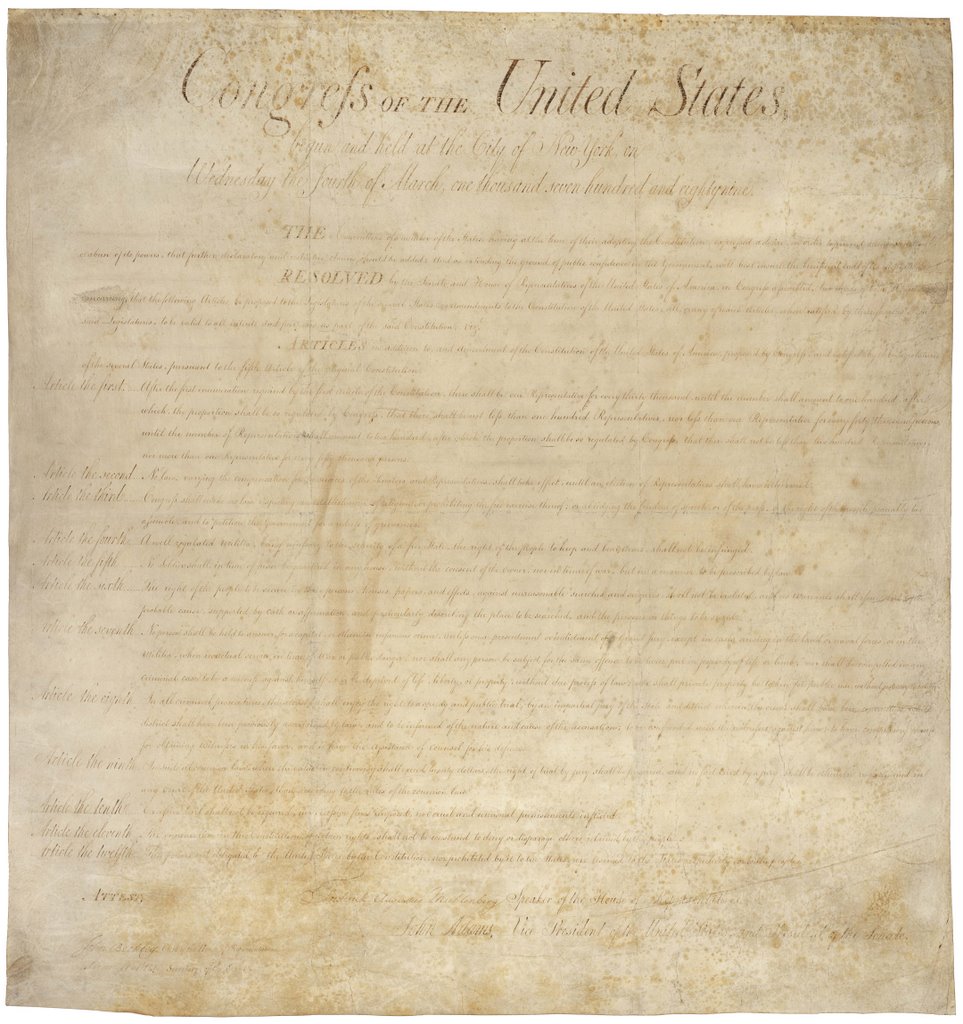
My proposal: The Second Amendment protects an individual right to bear arms as such arms existed at the ratification.
Arms in 1791

Let's look at arms – specifically, guns – as they existed at the time of the ratification.

Guns in 1791 WOULD
Guns in 1791 WOULD NOT
Courts can't wish the Second Amendment away, but they can construe it in a manner that works in today's society.

Arthur Goldberg, the little-remembered Supreme Court Justice who sat on the bench from 1962 to 1965, has been long-derided by social and political conservatives as something of a fool due to his concurrence in Griswold v. Connecticut, where he found a right to privacy in the Ninth Amendment. Lately, these same conservatives have been quoting and paraphrasing Justice Goldberg when they say things like "while the Constitution protects against invasions of individual rights, it is not a suicide pact," a line Justice Goldberg included in Kennedy v. Mendoza-Martinez, 372 U.S. 144, 159-60 (1963). Applying an admittedly severe form of originalism to cabin the Second Amendment prevents the kind of suicide pact that Goldberg was worried about.

Michelle Obama created a bit of a stir earlier this week when she talked about how the need for guns might vary regionally within the United States. A backstop interpretation of the Second Amendment – one that only protects the individual right to bear arms as they stood in 1791 – permits states to develop right to bear arms appropriate to their circumstances.

Labels: ,

Monday, September 24, 2007

Ahmadinejad on Campus

These remarks are entirely my own and I do not speak for ACS or the Columbia chapter thereof. I offer my responses to President Ahmadinejad's appearance with the sincere hope that this may be the beginning of a robust discussion here on columbiaacs.blogspot.com.

Today, the President of the Islamic Republic of Iran, Mahmoud Ahmadinejad, spoke and answered questions here at Columbia upon the invitation to join in the World Leaders' Forum. News vans, police, and passionate discourse all followed him here, and I - for one - cannot imagine a better use of the University's resources and good name.

Ahmadinejad is an indisputable threat to global security of the highest magnitude. He is also a genuinely bad person, a "petty and cruel dictator," in the words of University President Lee Bollinger. I join President Bollinger's condemnation without qualification. Ahmadinejad is, however, undeniably a "world leader," and it is, as noted by President Bollinger, the duty of the academy to host and critically engage with all viewpoints, ridiculous or otherwise.

Deeply embedded in the American conception of free speech is the idea that society benefits from a free trade of ideas in an open and diverse 'marketplace' of thought. It is only when juxtaposed with considered and rational ideas that the absurd and evil are revealed convincingly as such. Ahmadinejad began by dismissing Bollinger's criticisms as impolite as coming from a host, and moved to discuss the importance of scholarship as advancing civilization.

It was tactful of the Iranian President to frame his remarks as focused on the advance of knowledge. By entrenching his discussion in religious scripture, Ahmadinejad implied his fundamental and ultimately problematic thesis: truth is bestowed by God, and my God bestows my truth.

Predictably, Ahmadinejad used this platform as an opportunity to criticize the "big powers" of geopolitics. He pointed to American hypocrisy in preaching freedom abroad while denying privacy to its own citizens. A point well taken. He argued that the West uses science and scholarship to suppress indigenous cultures and the scientific advance of periphery nations, like his own. The intellectual leaders of the West, are divorced from human and cultural values, he argued, and this divorce renders Western science impure and unholy.

Ahmadinejad ended with two questions. First, he asked why more diverse scholarship investigating the Holocaust has not been produced. In a way, he turned President Bollinger's criticism of his government's stance toward the academic community back against the West. In that, he revealed an important and overlooked common ground: we must all observe and respect divergent viewpoints and secure safe spaces for such discourse.

Without phrasing it as a question, Ahmadinejad next asked why Iran should be denied the right enjoyed by other nations to develop a peaceful, civil nuclear program.

To me, Ahmadinejad's visit was an incredible intellectual opportunity and reminded me that the academy, and Columbia in particular, serves as an important and volatile center of international discourse. Ahmadinejad himself comes across as evasive, obfuscating, and an entertainer; ever playing the victim and avoiding any discussion of the magnitude of his inflammatory remarks.

In the end, President Bollinger's scathing introduction seemed, to me, to capture today's event aptly. Ahmadinejad cannot, with reason, refute the malevolence and irrationality of his publicly-expressed views. This is the lesson of the day: all views must be considered, but all must also be supported with reason and evidence. President Ahmadinejad's evasion and selective use of Western ideas are unpersuasive and uselessly polemical.

Labels: ,

Wednesday, August 29, 2007

2008 GOP Candidates: U.S. Founded as Christian Nation.

1797 Congress: No It Wasn't.

In Conroy v. Aniskoff, 507 U.S. 511, 520 (1993), Antonin Scalia includes a comment that he repeated here at Columbia Law School in 2006 — that the use of legislative history to bolster one's own position is "the equivalent of entering a crowded cocktail party and looking over the heads of the guests for one's friends." As much as I agree with Scalia here, I find it heartening to stumble across this bit of congressionally approved language from the 5th Congress:
Treaty of Peace and Friendship, signed at Tripoli November 4, 1796 (3 Ramada I, A. H. 1211), and at Algiers January 3, 1797 (4 Rajab, A. H. 1211). Original in Arabic. Submitted to the Senate May 29, 1797. (Message of May 26, 1797.) Resolution of advice and consent June 7, 1797. Ratified by the United States June 10, 1797. As to the ratification generally, see the notes. Proclaimed Jane 10, 1797.

ARTICLE 11

As the government of the United States of America is not in any sense founded on the Christian Religion,-as it has in itself no character of enmity against the laws, religion or tranquility of Musselmen,-and as the said States never have entered into any war or act of hostility against any Mehomitan nation, it is declared by the parties that no pretext arising from religious opinions shall ever produce an interruption of the harmony existing between the two countries.

Labels:

Monday, April 16, 2007

2nd Amendment Basis or Objective Basis for Firearm Ownership?

Although I do not agree with people who find a right to privately own firearms in the 2nd Amendment to the Constitution, I see their point. This amendment — along with a Congressional Commerce Power limited only by prudence and a 9th Amendment that either does nothing or everything — represents some of the most ambiguous, sloppy drafting in the entire Constitution. Although I don't think you have the constitutional right to buy one gun per month (a limit Virginia has placed on individual gun ownership), I see how people can seize upon the 2nd Amendment's sloppy drafting to claim that they do have such a right.

On the other hand, the people whom I do not understand are those people who ignore the historical accident of the 2nd Amendment and attempt to argue from first principles that a universally armed society is preferable to a less-than-fully-armed one.

When Kathryn Lopez, conservative blogger at The Corner on National Review Online, says:
If you want domestic tranquillity, an armed and responsible citizenry ready and able to protect life and property is not a bad way to start.
...she is calling for a type of Wild West society that has been rejected by the rest of the developed world.

Argue from the Constitution that you have a 2nd Amendment right to private gun ownership and I'll begrudgingly admit that you have a textual leg to stand on. Argue from first principles that the best society is one where we're all armed and I'll remind you that you stand in sharp disagreement with the rest of the developed world.

Labels:

Monday, April 02, 2007

PROPERTY RIGHTS POST-KELO

     Today, the Environmental Law Society, ACS, and Federalist Society welcomed John Echeverria of the Georgetown Environmental Law & Policy Institute, and Timothy Sandefur, of the Pacific Legal Foundation, to discuss the implications of the Supreme Court's 2005 decision in Kelo v. New London. The event began with Professor Tom Merrill offering a broad legal, political, and historical explication of the tension between property rights and government management of land use.
     Mr. Echeverria spoke first, beginning with a flat-out condemnation of the "regulatory takings agenda." He characterized this agenda as an effort to sabotage the workings of government in responsible management of land. The Takings Clause, Mr. Echeverria argues, should be applied narrowly to actual takings and invasions of property, citing an opinion written by Justice Scalia asserting such an interpretation. Mr. Echeverria traced the development of the "regulatory takings agenda" to the academic work of Richard Epstein, however declared it a "flop" given consistent Supreme Court holdings restricting the doctrine of regulatory takings to those situations in which regulation effectively constitutes an actual taking of the property. Turning to considerations of public policy, about half of the states have some sort of regulatory takings legislation. Aside from a referendum in Oregon (Measure 37), which Mr. Echeverria chalks up to electoral manipulation, the state policies are largely symbolic. Analyzing the slate of over 20 referendums at issue in the 2004 election, Mr. Echeverria optimistically points out that those propositions focused narrowly on eminent domain were successful, while those confounding that issue with regulatory takings failed. Concluding with an observation on the experience in Oregon, Mr. Echeverria notes that the regulatory takings argument for land-owner compensation fails because the regulation applies to all in the community, and therefore protects a complaining land-owner while inhibiting them. Therefore, those who seek compensation under the theory of regulatory takings really seek an individual exception to a mutually beneficial land-use regulation.
     Mr. Sandefur began his comments with a rejection of Mr. Echeverria's presentation and a plug for his recent book. Beginning at the beginning, Mr. Sandefur parsed the language of the 5th Amendment and sought to demonstrate the blurry line between physical takings and an outright and absolute restriction of the uses of a given property. Mr. Sandefur equated the post-Kelo world with Hobbes' nasty and brutish state of nature. The theories of John Locke informed the founders' thinking, and as such, the government is limited by theories of natural rights: the government cannot wrongfully abridge one's natural property right. Mr. Sandefur argued that "liberty trumps democracy," and that the Constitution created a government that should serve as a "bank guard" and restricted that guard from robbing the bank himself.
Attacking the tenets of progressive political thought, Mr. Sandefur generally criticized progressives' willingness to submit to majority views on the meaning rights. Mr. Sandefur went on to criticize the "rational basis" standard of review as a crippling and irrational judicial standard as the product of the progressive view. Coming around to the effects of Kelo, Mr. Sandefur points out that eminent domain reform has no natural constituency, while regulatory takings reform does have strong and financially-capable support. Mr. Sandefur characterized the argument against regulatory takings as "we can't afford it, so we should get it for free." He noted that forcing the government to pay for regulatory takings would compel more rational policy-making by forcing the government to bear the costs of their choices. Mr. Sandefur ended with his opening question: "what is a legitimate government interest." In crescendo, he asks: "If we don't know what a legitimate government interest is, what business do we have determining what a rational basis for one is?"
     Compelling argument throughout the hour, the issue of regulatory takings taps into deep philosophical questions about the purpose and powers of the federal government. The ACS, ELS, and FedSoc would like to thank both Mr. Echeverria and Mr. Sandefur for their dynamic, adversarial, entertaining, and genuinely thought-provoking comments.

Labels: ,

Wednesday, February 28, 2007

You, Yes, You Own the Military, So Help Fix It

Today’s Don’t Ask Don’t Tell panel consisted of two lawyers from the Servicemembers Legal Defense Network (SLDN) and two former military officers.

The panel began with an overview of the current effects of the Don’t Ask Don’t Tell policy (10 U.S.C. § 654). The Don’t Ask part of the statute prevents the military from asking about sexual orientation when someone joins. However, once in the military, a gay service member must constantly guard his words and actions or suffer the consequences of being outed to his superiors. 11,000 service members have been discharged since the policy was enacted in 1993, with an average of 2 discharges per day.

The two service members on the panel gave a personal view of the DADT policy at work. Cholene Espinoza spoke about remaining in the military while hearing about other service members who were discharged for being gay. Having taken the military oath not to lie, steal or cheat, nor tolerate others who do, Espinoza acknowledged the deep irony that in order to remain an officer, she was forced to lie about her own identity as a lesbian. Because of the DADT policy, Espinoza called the military “broken.”

“You own it,” said Jeff McGowan, reminding the audience that all Americans have the capability and responsibility of pushing the military to change its discriminatory policy. The Constitution, after all, placed the military under the authority of a civilian government of the people, and that remains equally true today.

McGowan also pointed out in response to a student question that the military is using the same arguments against allowing openly gay service members as were used to oppose the integration of blacks into the military. Those arguments are only a pretext for discrimination. Many countries have openly gay service members, including Britain and Israel, disproving the argument that Don’t Ask Don’t Tell is necessary for the unity and morality of the American military.

The DADT policy is being challenged in the courts on the grounds that it violates the substantive due process and equal protection clauses of the Constitution and suppresses First Amendment rights. In Congress, there are more than 100 cosponsors for the Military Readiness Enhancement Act (H.R. 1059), a bill seeking to repeal Don’t Ask Don’t Tell.

In addition, the fight continues against the Solomon Amendment (10 U.S.C. § 983) despite the recent Supreme Court decision upholding its constitutionality (Rumsfeld v. FAIR). The Solomon Amendment threatens to withdraw federal funds from any university that prohibits military recruiting. In essence, it silences universities, preventing them from expressing their disapproval of the military’s DADT policy, a questionable use of the Congressional spending power.
(More on this subject after this weekend’s GALLA conference at Harvard Law School.)

Labels: ,

Friday, February 02, 2007

Following Up: Chilling Representation

Defense Department official Charles "Cully" Stimson – who angered Whitney and many others with his encouragement that corporate America boycott law firms that provide pro bono representation to detainees at Guantanamo – has finally resigned.

Labels: ,

Saturday, January 27, 2007

In Defense of the Second Amendment

The Second Amendment is a lot like the Ten Commandments. Often invoked, but rarely read.

Do you know anyone who can actually quote the Ten Commandments? Stephen Colbert exposed how not a few proponents of the Commandments can barely name three of them. To avoid a similarly embarrassing incident, I'll quote the 2nd Amendment in full: "A well regulated Militia, being necessary to the security of a free State, the right of the people to and bear Arms, shall not be infringed."

If I were an academic (or a Federalist), I would endlessly parse those 26 words. The big debate has been whether the 2nd Amendment grants a collective or an individual right. Essentially, this boils down to one question: Do we emphasize the first half or the second half of the 2nd Amendment? I don't really care about the answer, but, if you're of the nerdy bent, read Prof. Dorf's take. Or, read the entire symposium dedicated to the topic.

Instead, I would like to focus on what's good policy: I want to convince you that Congress should keep its tentacles off gun control -- regardless of what Constitution allows. A national ban on handguns has been a dream of liberals worldwide for at least a decade. Not only is this bad politics, it's bad policy. With a handful of exceptions, we should declare a Congressional cease fire in the federal regulation of guns.

This ultimatum may sound like it applies only to Brady Bill Democrats, but it applies equally to Republicans, who've shown themselves all too willing to exploit the 2nd Amendment for cheap political points -- all the while trampling on our beloved federalism. Stunningly, the "Do Nothing" 108th Congress attempted to repeal all DC guns laws -- even the one that criminalized possession of unregistered guns. Republicans should stop appeasing their NRA donors and heed their own "states' rights" ideology. Meddling in DC's right to regulate itself (on the gun question and everything else) is just as bad as foisting NYC's gun laws on Wyoming.

So, what's so wrong with more federal gun laws? One word: federalism. I know, I know, this is ACS, and progressives are generally in favor of the Interstate Commerce Clause's virtually unlimited expansion of Congressional authority. But, just because Congress can regulate pretty much anything, doesn't mean that it should.

1.) One Size Does Not Fit All States
Nations of our size (e.g. Australia, Canada, Russia) have favored a federal form of government -- because it's really hard to craft policies that suit an entire continent.

That said, there are plenty of good reasons for national laws. For one, they facilitate planning. Getting to JFK via public transit would not be such a mess if one government authority had built a regional transit solution -- instead of the fragmented mess that we have. National laws also bring uniformity, which facilitates banking and other business enterprises. Another good reason is negative externalities -- particularly pollution. Raw sewage defies borders. It flows downstream (or blows westward). Unilateral action by one state will only ensure that they're on the receiving end of all the sewage. As a result, pollution is one of those problems that requires national environmental laws (with teeth, preferably).

But, none of these reasons justify additional national gun laws. Our current federal framework is pretty sensible: you can buy a rifle or shotgun at 18 -- but must wait until 21 to buy a handgun; felons cannot buy guns; all guns must be registered; sales of multiple handguns require ATF notification. Federal laws already prohibit gun trafficking. Beyond this foundation, each state should be free to restrict or expand rights as they see fit.

Unless stolen, guns do not travel with the wind injuring third parties. Sure, guns can cause harm: they are used as a tool in suicide, accidental shootings, domestic violence, and countless crimes of greed. But, these harms generally cluster in the state in which they are used -- and should be addressed there, not in Congress.

2.) Fairness
Why should South Dakotans be punished for the sins of New York City? Guns are huge problem throughout urban America. But, all the maladies seen here in NYC have not infected states like Wyoming, Alaska, Wyoming, Montana, etc. Because of the ubiquity of hunting, accidental deaths are low in most rural states -- except when Dick Cheney is around. Crime is also low. Suicide rates are no higher than in urban America (and probably are lower). In fact, the use of guns in domestic violence is the only good argument for additional gun regulations in places like South Dakota -- and, there are better ways of reducing domestic violence than emptying the gun cabinet.

3.) Guns as the Whipping Boy of the Left
Every week, there seems to be a new workplace or school shooting. No other industrialized nation is plagued by our epidemic of violence. It's appalling that we are the model for the world, our social fabric is in tatters. So, what do we do about this spiral of violence? It's really easy to blame guns. In my home state of Wisconsin, a hunter went berserk (mid-hunt) and shot several other men out hunting in the same forest. These kind of attrocities simply did not happen 50 years ago -- despite children's ready access to guns in rural America.

Furthermore, when rifles and shotguns are the tool of choice for these acts of suicide-by-cops-and-teachers, it's intellectual laziness to blame the NRA. One can't seriously advocate limiting hunters' access to shotguns. At least, one can't if you've ever lived in Wisconsin or South Dakota.

The NRA is hardly a servant of the people, but I can't help but agree that it's people that kill people -- not guns. National gun laws will do nothing to kill the social rot evident in the countless school and workplace shootings. Maybe...instead, we should do something about all the people bowling alone? Or, about people watching Bill O'Reilly? Here's my bet: increased social competition, stress in the workplace, urbanization, rapid growth, and the destruction of our social safety net have prompted our violence crisis.

4) The State Solution: Experimentation
Why not exploit one of the prime virtues of our federal system, experimentation, to find the best policy? In states that do have serious gun problems, legislatures should be free to add as many restrictions as they like -- leaving the remaining states to grant conceal-and-carry licenses and other means to expand gun rights. If guns are truly such a social plague, then largely rural states will eventually start restricting gun rights. Until then, leave them be.

Further federal encroachment on the 2nd Amendment is contrary to fairness, federalism, and freedom -- and therefore contrary to the mission of ACS.

Labels:

Wednesday, January 24, 2007

A Toast to the American Constitution Society, the Federalist Society, and the Agreed-upon Constitution

By popular demand, here's the toast from the Columbia Law School's ConLaw Mixer, held on January 23, 2007. The event was jointly hosted by the local chapters of the American Constitution Society, the Federalist Society, and the Constitution Law faculty here at Columbia.

When ACS President Jon Sherman asked me to say a few words for this event, I initially thought I’d focus on the differences in how the American Constitution Society and the Federalist Society approach the Constitution.

I mean, every ACS member knows that the members of the Federalist Society look longingly at the days before pasteurization — that they fancy themselves as yeoman farmers on the New Jersey frontier where they dream of a world in which interchangeable parts will someday be a reality.

Similarly, every FedSoc member knows that when the members of the American Constitution Society hear someone talking about "penumbras formed by emanations," they promptly instruct the bartender that they’ll have what that guy’s having.

. . . but these differences are minor. Today, let’s celebrate the similarities — of which there are many. I’ve spent the past couple days pouring over this document, locating areas of significant agreement. I’ve found three areas of broad agreement about the Constitution. Interpretations upon which we can all agree, areas that we can all toast.


AREA #1: We agree on the many of the powers assigned either to the states or the various branches of our federal government.

What does this mean?

For the States, we shall not rest until states stop granting Letters of Marque and Reprisal and until they stop granting Titles of Nobility. We insist they settle their past debts using gold or silver.

For the Congress, we demand that it not shirk its duty to establish post Roads, to erect needful Buildings in D.C., and — as stated in Article 1, Section 5, clause 2 and reiterated the 20th Amendment — that it meet at least once every year.

For the Judiciary, we insist it remain vigilant to the needs of justice, that it insure no Attainder of Treason work Corruption of Blood, and that no one shall not be convicted of Treason without a rigorous trial consisting of at least 2 witness presenting evidence against her.

Most importantly, we ask that the judiciary fully enforce the 11th Amendment, whether that amendment actually means what it says . . . or whether actually every word of that amendment means the exact opposite of what it appears to mean.

Finally, concerning scope and appropriate exercise of Executive power, we… you know what, let’s just move on to Area #2.


AREA #2: I know I speak for everyone in this room when I say we supports the passage of the original 1st Amendment — the Congressional Apportionment Amendment.


As many of you know, on September 25, 1789 the 1st Congress introduced 12 — not 10 — amendments to the states as the Bill of Rights.

The original 2nd Amendment — barring Congress from granting itself immediately effective pay raises — became the 27th Amendment on May 20, 1992. However, the original 1st Amendment was only ratified by 11 states — 2 shy of passage at the time. Since Coleman v. Miller makes clear that all amendments are considered pending before the state indefinitely unless Congress establishes a deadline within which the states must act, only 27 states are now needed to ratify this amendment for its passage. Hey 27 states, pass the original 1st Amendment.

If passed, the Congressional Apportionment Amendment would establish guidelines for the size of the House of Representatives. The Amendment’s math is a little hazy, but it ends with this important instruction: "there shall not be . . . more than one Representative for every 50,000 persons."

With a present US population of more than 300 million people, this introduces the possibility of a 6,000-member House of Representatives. I know I speak for everyone here when I say that if there’s one thing that the august body of the House needs to be truly effective, it’s to have 5,565 members added to its ranks.


In closing, Area #3 is really a pledge:

AREA #3: We pledge from this day forth that we shall write like the authors of our Constitution.

Not only shall we employ capitalization seemingly at random and use either British, tortured, or inconsistent spelling whenever possible, but — like the Constitution’s signatories — we shall sign our name to documents using absurd abbreviations.

I mean, why grace the document with your full name — it’s only a Constitution? These people, these founders, signed the Constitution with all the formality of someone signing a traffic ticket. William Blount went with the predictable "Wm." but William Livingston chose the path of a hipster, abbreviating "Wil:" Jonathan Dayton became "Jona:" Robert Morris became "Robt." . . . and anyone who has studied with Professor Hamburger will know who I’m talking about when I tell you that one of them merely signed "Gouv."

5 of the signatories determined that their signatures constituted little micro-sentences, worthy of ending with a period. We, too, shall end our signatures with periods. From this day forward, if you see a document signed "And: Brad:." know that it is me.


As you can see folks, our points of agreement are broad and substantial. So here’s to our agreements and our differences, here’s to our faculty and our constitutional societies, and here’s to the wig-and-tight-pants-wearing founders who made it all possible. Cheers!

Labels: , , , , , ,

Wednesday, January 17, 2007

Chilling Representation

Last week, the deputy assistant secretary of state for detainee affairs condemned specific law firms for their pro bono representation of detainees at Guantánamo. Speaking in an interview with Federal News Radio, Charles Stimson suggested that such firms’ corporate clients should pressure the firms to “choose between representing terrorists or representing reputable firms.” Though a Pentagon spokesman stated on Saturday that Stimson's comments “do not represent the views of the Department of Defense or the thinking of its leadership,” and Stimson yesterday issued an apology, his statement nonetheless has a chilling effect on pro bono representation and freedom of association.

In today’s complex legal world, access to justice depends heavily upon legal assistance. And yet for certain individuals, legal assistance is difficult to secure. For detainees in Guantánamo, counsel is not provided (as it would be to criminal defendants), and the obstacles to obtaining counsel are myriad: language, distance, political unpopularity, and, perhaps most significantly, the military rules governing contact with detainees. Detainees cannot themselves retain counsel. Despite these obstacles, law firms have extended their services to these individuals on a pro bono basis. By denigrating the value of these services, Stimson does real damage to the norm of pro bono work. The Association of the Bar of the City of New York recognizes the importance of such work, citing “the fundamental ethical and professional obligation of all lawyers to render pro bono legal service…” I would expect that Stimson, as the recipient of a law degree from George Mason University Law School, would recognize it too.

Beyond the effects of his interview on law firms’ pro bono representation, Stimson’s remarks sounded a disturbing echo of McCarthyism, selecting and disclosing the names of law firms whose activities are politically inconvenient in an effort to blackball them into changing their behavior. Given that juror selection began this week in the trial of Scooter Libby, I would think that the administration might be more careful about disclosures intended to chill politically unpopular activities. Stimson’s interview, and the subsequent lack of retraction, indicates a senior administration official’s strategy of achieving political ends by chilling constitutionally protected behavior - a strategy that I (idealistically, perhaps) had hoped ended long ago.

Labels: ,

Thursday, November 23, 2006

If I Include "Second Amendment" in the Title of My Bill, Does that Make it a Proposed Amendment?

There are many reasons for Congress to consider legislation. One of the primary reasons for Congress to consider legislation is that it believes that the judiciary will not find the subject matter of the statute already protected by the Constitution.

Last Thursday, Lame Duck Virginia Senator George Allen proposed SB 4057, tentatively titled The National Park Second Amendment Restoration and Personal Protection Act of 2006. According to the current description of the bill, it would "protect the second amendment rights of individuals to carry firearms in units of the National Park System." If passed, it would permit a properly licensed individual to carry a concealed weapon in a National Park.

Of course, the bill's title and short description do nothing other than to obscure the bill's point and confuse debate. The Second Amendment doesn't grant you the right to carry a concealed weapon in the National Park System. That's why you're proposing this law.

Labels: ,

Sunday, November 19, 2006

Failed Amendments We Have Known & Loved

Barring an unexpected Lame Duck attempt to amend the U.S. Constitution, Democratic control of Congress will probably result in a temporary moratorium on proposed amendments to the Constitution that would ban gay marriage or ban burning Old Glory.

Of course, the G.O.P. does not have a monopoly on converting a Congressional majority into failed attempts to amend the Constitution. During the next 2 years of their pending majority, if the Democrats need to find examples of entertaining failed attempts to amend the U.S. Constitution, history provides some real doozies.

In this post, we'll explore three prominent categories of failed Constitution amendments.
Zombie Amendments:
Approved, Not Ratified, No Expiration Deadline


Starting in the early 20th century, Congress began placing deadlines on the amendments it sent to the states for ratification. Typically, the states were given seven years to ratify an amendment. After the passage of the deadline, the proposed amendment would expire and Congress would need to start the process all over again to raise the issue. (In the past 50 years, two amendments expired after Congressional approval: the 1972 Equal Rights Amendment & the 1978 D.C. Voting Rights Amendment)

However, absent explicit sunset provisions, approved yet unratified amendments do not expire.1 Instead, they linger eternally, pending ratification. As shown with the 27th Amendment, an amendment which floated around for 200 years before finally being ratified in the 1990's, each of these amendments has the potential of becoming law.

Congressional Apportionment Amendment: This proposed amendment was the first of the original twelve amendments proposed to Congress (The original 2nd Amendment eventually became the 27th Amendment mentioned above). If passed, the amendment would have restricted the original size of the House of Representatives to 100 representatives, with later enlargements to be determined by Congress. From 1789 to 1792, 11 states ratified this amendment, leaving it two states short of ratification.

Titles of Nobility Amendment: Proposed in 1810, this amendment would strip U.S. citizenship from any citizen accepting, claiming, retaining, or receiving a foreign title of nobility without the consent of Congress.

Believed by some [See here and here. For a rebuttal, see here. (Apply salt liberally to the arguments on these web pages.)] to have been ratified and then supressed by a conspiracy of lawyers (who – so the theory goes – would lose their citizenship via their esquire title), this amendment was approved by 12 states, just one shy of full ratification. Since, at the time, it came within one house of the South Carolina legislature of being ratified, some 19th century printings of the Constitution erroneously include it as the 13th Amendment.2

Pro-Slavery Amendment: A last-ditch effort to avoid a civil war, this amendment – approved by the House and Senate on Februrary 28 & March 2, 1861, respectively – stated simply:
No amendment shall be made to the Constitution which will authorize or give to Congress the power to abolish or interfere, within any State, with the domestic institutions thereof, including that of persons held to labor or service by the laws of said State.
Apart from its subject matter, the language of this amendment raises an important issue in U.S. Constitutional theory: Can a Constitutional amendment prohibit a later amendment through an entrenched clause?

Although this amendment was ultimately ratified by Ohio and Maryland, neither legislature ratified it before the start of Civil War hostilities with the Battle of Fort Sumter on April 12, 1861.

Child Labor Amendment: Proposed in 1924 and ratified by 28 states, this still-pending amendment requires the approval of 10 more states in order to restrict to the federal government all power to regulate the labor of persons under 18 years old.

This amendment is a direct reaction to the Child Labor Tax Case,3 which found Congress had overstepped the boundaries of the 10th Amendment with the scope of the taxes it placed on factories employing child labor.

Let's Remake America Amendments:
Ambitious Attempts to Change this Country

Had they been ratified, these proposed amendments would dramatically change the way our country works.No Way, José Amendments:
That's Just Crazy Talk

These proposed amendments were going exactly nowhere, but that's why we like 'em.

1 Coleman v. Miller, 307 U.S. 433, 454 (1939) (Finding that all amendments are considered pending before the states indefinitely unless Congress establishes a deadline within which the states must act.)

2 In Campion v. Towns, 2005 WL 2160115 at *1 (D. Ariz. 2005), a tax protester produced an 19th century archival copy of the Constitution incorrectly listing the Titles of Nobility Amendment as the 13th Amendment. Needless to say,
the argument based on the existence of this document did not go very far with the Court.

3 Bailey v. Drexel Furniture Co., 259 U.S. 20 (1922)

4 354 U.S. 1 (1957)

Labels: , ,

Thursday, October 26, 2006

So, What is Our Freedom of Speech at CU?

We're all aware that free speech is a hot topic at Columbia recently. The violence at the Minutemen speech was an interesting intersection of free speech in the right to protest and free speech in its pure form. As Bollinger pointed out in his first response, it's part of the American ideal of free speech that even ideas we disagree with should be allowed to be heard, and that we should counter them by exercising our own right to free speech, not through suppression. Various student groups replied that for some, the presence of the Minutemen is not a free speech issue; it's creation of a hostile environment. Less emotionally affected groups pointed out that Bollinger has excluded other speakers from campus because of security concerns, and that perhaps he should have exercised that discretion in this instance; and as a larger point, that the exercise of his discretion needs to be more transparent, with guidelines for student groups to work with.

All of this raises a threshold question for me (keep in mind I'm a 1L, so I haven't taken Con Law yet): What is the place of freedom of speech at private institutions? And at the particular kind of institution that Columbia represents?

According to the Foundation for Individual Rights in Education (FIRE), a watchdog group for freedom of speech on college campuses, private universities are not bound by the First Amendment. No surprise there. But FIRE then points out that most universities represent themselves as forums for debate and free thought and expression, and that they have a duty to adhere to that representation – which in many cases would mean using the same standard as a public university (which can, of course, limit the time, place, and manner of a speech so long as the limitation is without discrimination). Furthermore, FIRE points out, “private colleges and universities are contractually bound to respect the promises they make to students.” So what promises has Columbia made us regarding free speech? (Side note – Columbia gets a “red light,” the worst designation, on FIRE’s map of colleges across the nation.)


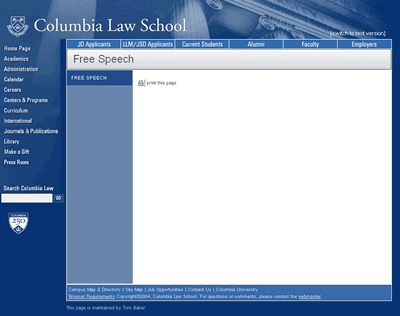
Oddly, the CLS free speech page is blank (does this have a meaning of its own?). Bollinger’s message in response to the Minutemen protest says that Columbia is dedicated to “respect[ing] the rights of others to express their views…students and faculty have rights to invite speakers to the campus. Others have rights to hear them. Those who wish to protest have rights to do so.” He then refers to “extensive University policies governing the actions of members of this community with respect to free speech and the conduct of campus events.” But I can’t find them. Maybe because I’m not a leader of an organization at Columbia, or because they’re not posted online. That might be first step toward repairing Columbia’s free speech reputation.

According to a Columbia Spectator article, however, Columbia’s position on free speech is in the appendix of the student handbook, Facts About Columbia Essential to Students. According to the article, the handbook states, "While the University as a private institution is not subject to the Constitutional provisions of free speech and due process of law, the University by its nature is dedicated to the free expression of ideas and to the evenhanded and fair dealing with whom it conducts its affairs." Apparently the handbook then goes on to say that protests and petitions are regulated by the University's rules in order to "protect the rights of all members of the University community." Some of these regulations include scheduling student protests with Columbia security, and the University’s right to restrict students from interfering with events on campus.

Student leaders quoted in Part II of the article, however, do say that cost of speakers and security are the biggest roadblocks to bringing speakers to Columbia, and that they’ve never seen a proposed speaker rejected for viewpoint or content. The article leaves the question hanging, however, of whether the University’s policies on security discourages student groups representing the minority from bringing controversial speakers, because the required security is so much more expensive.

Professors quoted throughout Part I of the article – including Dorf – emphasize that while the university is committed to free expression, any commitment to the First Amendment is entirely voluntary. All of this brings us full circle: Other than what the university chooses to publicly say, that we can hold it to, we don’t have freedom of speech on this campus. And Columbia’s not saying much. Back to state schools, anyone?

Labels: ,

Tuesday, October 03, 2006

Gay Rights as the Cause of “Naughty Emails”?

By now, we’ve all heard about the inappropriate, lurid conversations, instant messages, emails, and possibly encounters of now-former Rep. Mark Foley, R-FL. The scandal has raised significant issues about accountability in Republican leadership and the oversight of the page problem in general. But many conservatives have been quick to characterize the problem differently- as one of an inherent problem with homosexuality, and in particular, a problem resulting from the granting of gay rights. Rather than seeing Mr. Foley as a troubled man, living in the closet (though he was outed in gay media in 1997), and abusing his power in a completely inappropriate way, members of the right wing are holding up Mr. Foley as an example of all gay men- and furthering the baseless accusation that gays are more likely to pursue relationships with children.

On one prominent right-wing blog sponsored by the inappropriately named “Accuracy in Media”, Editor Cliff Kincaid takes the media to task for not ascribing Mr. Foley’s behavior to his homosexuality, and takes the Republican Party to task for “protecting” Foley’s homosexuality, which he calls a perversion. The veritable Family Research Council has gone even further, saying that “Pro-Homosexual Political Correctness” is to blame for Rep. Foley’s behavior, saying that political correctness (or what we refer to as basic human rights and dignity) has come at the expense of child safety.

Disappointingly, these myths are being propagated by usually more reasonable right-wingers. The Wall Street Journal editorial page is claiming that Rep. Foley’s actions gives credence to the Boy Scouts of America’s anti-gay discriminatory policy. Ben Stein, former host of “Win Ben Stein’s Money” and Nixon Administration official, writes in the American Spectator, “I hope it won't come as a surprise to anyone that a big part of male homosexual behavior is interest in young boys.”

As a practicing male homosexual, I will be honest- it surprises me. Homosexuals, like heterosexuals, have a wide range of tastes in sexual partners. To say all male homosexuals have an “interest” in young boys is as absurd as saying all male heterosexuals have an interest in retired senior citizens from South Florida. Others are saying that the fact that Rep. Foley found 20-year old men attractive should have been signs of trouble. Many older heterosexual men find 20-year old women attractive—that doesn’t mean they’re pedophiles. The double standard is fairly clear.

Stein also argues that LGBT individuals aren’t expressing their support for Rep. Foley as they have for other gays involved in scandals. But there is a difference between supporting someone’s homosexuality and ability to openly express it, and supporting their inappropriate behavior. Had Rep. Foley simply “come out”, he surely would have had as much support as any other politician who has decided to cease hiding his sexuality.

If anything, the continued repression and subordination of LGBT Americans likely had a greater influence on Mr. Foley’s behavior than “political correctness.” I do not condone Mr. Foley’s behavior in any way, but the fact that Mr. Foley’s homosexuality is part of the “news” at all is a sad commentary on the state of affairs in this country. If the circumstances of his affair were exactly the same, but merely concerned female pages instead of male pages, Mr. Foley’s behavior would have been as inappropriate and unacceptable. However, the sad truth is that the scandal would likely be considered more forgivable if the pages involved were female.

The only sympathy that Mr. Foley deserves today is due to the fact that he could not be openly gay throughout his tenure as a legislator. (Currently, there are only 3 openly gay members of Congress- .6%) In fact, when rumors started swelling around his 2003 Senatorial run, he left the race rather than admit that he was a gay man- facing the choice between being himself openly and his career- a choice that too many LGBT Americans face daily. To save face, Mr. Foley even went so far as to say “I like women…” and call it "revolting and unforgivable" that people were openly speculating that he was gay.

The good news is it seems unlikely that the majority of Americans will buy the argument that treating LGBT Americans with respect, dignity, and the equal protection of the laws “caused” Mark Foley’s immoral, condemnation-worthy behavior. Mark Foley’s inappropriate behavior towards pages cannot be used to justify discrimination towards LGBT Americans. LGBT Americans deserve to be treated with equal rights, and Mr. Foley’s actions are condemnable regardless of his sexual orientation. If anything, Mr. Foley’s inability to live openly as a gay man should remind us of the need to protect LGBT Americans, not rollback their civil rights.

Labels: ,

Wednesday, September 27, 2006

Geoff Stone visits the CLS ACS

Professor Geoffrey Stone, of the University of Chicago, addressed ACS and students at Columbia Law School this afternoon. His topic was the Bush Administration's response to The New York Times story on National Security Administration surveillance. The Bush administration suggested that the Justice Department look into criminal actions against several parties involved in leaking the classified information in the story. Stone identified three types of parties implicated in the pursuit of this type of criminal action: first, government employees who leaked classified information (defined as any information that threatened national security); second, the journalists who obtained the classified information; and third, the publishers who disseminate that information.


Stone found a conflict between the treatment of the government employee, who can be prosecuted for leaking the information, and the publishers, who are protected under the First Amendment for printing it - unless the publication creates a clear and present danger. Stone then rationalized the conflict, first by pointing out that prosecution of state employees for this type of offense does not generally raise a full weighing of First Amendment issues. He then pointed to an overlooked element of hypotheticals in which the press can be prosecuted for publishing classified information. Such hypotheticals include publication of military ship departure dates, or of invasion plans, and are generally described as creating clear and present danger. However, Stone also proposed that such information does not contribute to public discourse, and that the press is only protected under the First Amendment for publishing any information that contributes to public debate. Thus, he says, the double standard - the application of disperate doctrine to the state employee and the press - disolves.


However, the journalist is left in a murky middle area. Stone pointed out that any way a journalist receives classified information is likely to be in itself a crime; bribery, solicitation of the leak (thus inciting a crime), or even mere passive receipt of illegally leaked information. Stone left the audience with the questions of where to draw the line between what would and wouldn't be an illegal way to obtain information, and also of who can be considered a journalist for the purposes of First Amendment protection. A lively conversation ensued after Stone's remarks, and the Columbia Law School ACS would like to thank Professor Stone for his thought-provoking and informative address.

Labels: , ,

Monday, July 24, 2006

The Third Amendment: The Little Amendment That Couldn't

Stop what you're doing.

If you're a law student or a lawyer, the odds are pretty good that you're within easy walking distance of a copy of the U.S.C.A. Go to this multi-volume juggernaut.

The first umpteen volumes of this leather-bound behemoth are devoted to the U.S. Constitution and its amendments. Grab the volume dedicated to the first four amendments.

As you likely know, the U.S.C.A. is an annotated version of the codified statutes of the United States. Adjacent to a statute, the publisher (West) has attempted to include influential cases that reference that statute. Flip to the Third Amendment.

While flipping, you may have noticed that the First Amendment has about 150 pages of one-paragraph case synopses that illustrate how, over time, courts have interpretted the protections laid out in the First Amendment's 45 words.

If you flipped too far, you may have noticed the Fourth Amendment has about 400 pages of material dedicated to the constitutional protection against various unreasonable searches and seizures.

How many pages are devoted to the Third Amendment?

2

The republic is in its 230th year, with a constitution that is 217 years old. ...and yet there are 2 pages worth of cases that say anything interesting about the Third Amendment. Let's take a tour:

First, the text:
No Soldier shall, in time of peace be quartered in any house, without the consent of the Owner, nor in time of war, but in a manner to be prescribed by law.
Cornell's Annotated Constitution claims:
There has been no Supreme Court explication of this Amendment, which was obviously one guarantee of the preference for the civilian over the military. In fact, save for the curious case of Engblom v. Carey, 677 F. 2d 957 (2d Cir. 1982), on remand, 572 F. Supp. 44 (S.D.N.Y.), aff’d. per curiam, 724 F.2d 28 (2d Cir. 1983), there has been no judicial explication at all.
Au contraire. No fewer than seven cases have mentioned this sacred protective amendment, at least three of which bear mentioning.

First, back in the day of penumbras, a footnote in Katz v. US notes that this amendment protected at least one "aspect of privacy from governmental intrusion."1

Next, although the common law Ad Coelum rule (the rule's full name translates roughly as "To whomever the soil belongs, he owns also to the sky and to the depths.") was put out of commission 65 years before by Hinman v. Pacific Air Transport and its sister cases, the Custer County Action Association still forwarded an Ad Coelum-related theory in its 2001 case.2 The association claimed that peacetime military overflights were a per se unconstitutional quartering of soldiers on their property.3 Needless to say, the 10th Circuit disagreed rather heartily.

Finally, the last case bearing mention is Engblom v. Carey, which (as the quote above notes) is probably the only lengthy judicial discussion of the Third Amendment.4 Although I agree with Engblom's core holding, that National Guardsmen are "soldiers" within the meaning of the Third Amendment, I must sheepishly disagree with one of Engblom's other holdings — that the Third Amendment applies to the states via incorporation in the Fourteenth Amendment.5

Notwithstanding Barron v. Baltimore,6 it appears to me that the Third Amendment applies directly to state militias (given the National Guard's formation via the Militia Act of 1903, I'm treating them as state militias for the purpose of this argument.)

Article I, Section 10, Clause 3 reads:
No State shall, without the Consent of Congress, lay any Duty of Tonnage, keep Troops, or Ships of War in time of Peace, enter into any Agreement or Compact with another State, or with a foreign Power, or engage in War, unless actually invaded, or in such imminent Danger as will not admit of delay. (emphasis added)
Since a state could not maintain soldiers other than with the approval of Congress, since the Third Amendment says "No Soldier," not "no federal soldier," and since the Third Amendment provides a logical backstop to the militia power defined in the Second Amendment, it appears to me that the Third Amendment would have logically applied to the states before the Fourteenth Amendment made it so.


1 Katz v. US, 389 U.S. 347, 351 n.5 (1967).

2 Hinman v. Pacific Air Transport, 84 F.2d 755 (9th Cir. 1936); cert. denied, 300 U.S. 654 (1937); see US v. Causby, 328 U.S. 256, 261 (1946) (acknowledging that while a Fifth Amendment remedy might exist if flights over private property directly and immediately interfere with the enjoyment and use of the land, Congress has declared "[t]he air is a public highway" and "[c]ommon sense revolts at the idea" that aircraft operators would be subject to trespass suits based on common law notions of property ownership extending to the periphery of the universe). Black's Law Dictionary (6th ed 1990).

3 Custer County Action Ass'n v. Garvey, 256 F.3d 1024, 1042-43 (10th Cir. 2001).

4 Engblom v. Carey, 677 F.2d 957 (2d Cir. 1982), on remand 572 F. Supp. 44 (S.D.N.Y. 1983).

5 Id. at 961-62.

6 Barron v. Baltimore, 32 U.S. 243 (1833) (determining that the Bill of Rights did not apply to state governments).

(Thanks to Colin for the U.S.C.A. tip)

Labels: ,

Wednesday, May 17, 2006

I'm Glad I'm Not the Only One Who Finds Constitutional Law Challenging

The U.S. Citizenship and Immigration Services flashcards designed to help applicants study for US citizenship exam omit the freedom of the press.


The full(ish) set can be downloaded here (.pdf link).

Labels: